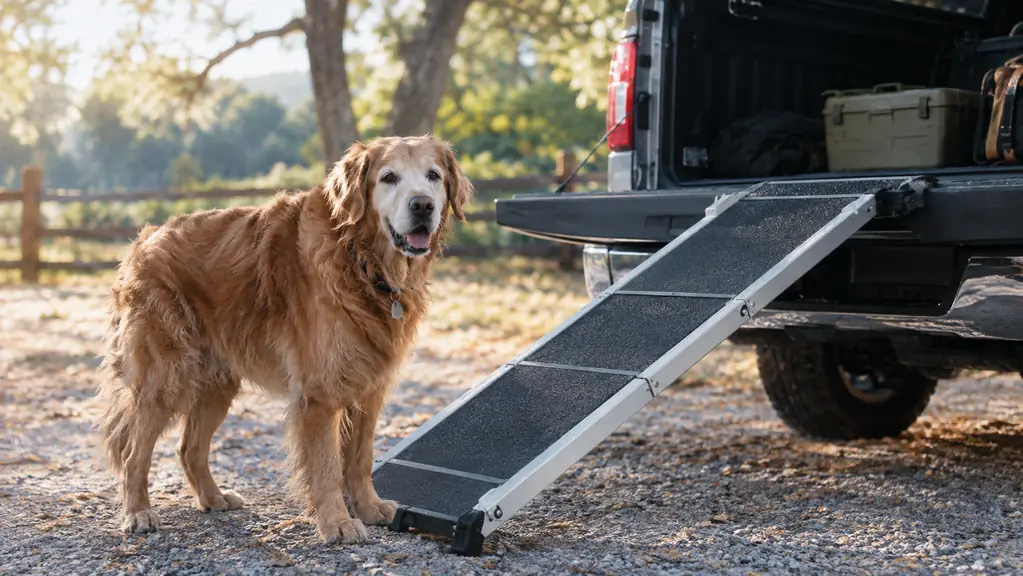
Murphy used to leap into the back of our pickup like he was still a puppy. He would plant his front feet on the tailgate, push off with his back legs, and land with a thump you could hear from the house. That thump is what I should have paid attention to years ago. At 12 years old and about 78 pounds, with stiff hips and elbows that our vet says are just a long life of swimming off the pontoon and jumping off tailgates catching up with him, Murphy does not jump anymore. He walks up to the tailgate, sets his nose on the edge, and then just stands there looking at me like he is embarrassed about it.
That is where the PetSafe Happy Ride folding ramp came in. The idea was simple: give Murphy a gentle slope instead of a jump. The training was the harder part. He had never walked on a ramp in his life, and the first time I set one up against the truck, he acted like I had asked him to walk a plank. So I took a breath, started over, and built up to it slowly with treats and patience. I will tell you right now, this is not a one-afternoon project. It took us two weeks, and that is with a dog who loves food and trusts me completely. Here is the step by step plan that finally got Murphy walking the ramp on his own, along with the mistakes I made so you can skip them.
The ramp that finally got Murphy into the truck
The PetSafe Happy Ride folds flat so it stores easily in the camper shell, and it gives a stiff senior dog a steady slope instead of a jump. It is the ramp we used for every step of this training plan.
Amazon Check Today's Price on Amazon →Before you start, two things. Pick a quiet time of day when your dog is calm and a little hungry, because treats do most of the teaching here. And if your dog is in pain, not just stiff, talk to your vet first. A ramp is a tool, not a fix, and I would not want anyone pushing a hurting dog up a slope. And have your treats ready before you bring the dog out. You do not want to be digging in your pocket while he is waiting.
Step 1: Let the ramp sit on the ground and let him sniff it
My first mistake was setting the ramp up against the truck and expecting Murphy to just use it. He took one look at that slope, turned around, and walked back to the house. I do not blame him. A ramp leaning against a tailgate looks like a skinny staircase to a dog who already struggles with stairs.
So I took it down and laid it flat on the grass. No truck, no height, no pressure. I put it in a spot Murphy already liked, in the shade near his water bowl, not in the middle of the yard where he had to cross it to get anywhere. I scattered a few treats along the surface and let Murphy investigate on his own schedule. He sniffed it, walked around it, and finally stepped on it to reach the treats. That was the whole goal of day one.
If your dog will not even walk near the ramp at first, you are not behind. You are right on schedule. Some dogs need a full day just to decide a folded ramp is not a threat. Leave it where they can sniff it whenever they want, and do not push. The first step is not teaching anything. It is convincing your dog the ramp is boring. Patience is the whole trick. The dog decides the pace, not you.
Step 2: Make the ramp the happiest place in the yard
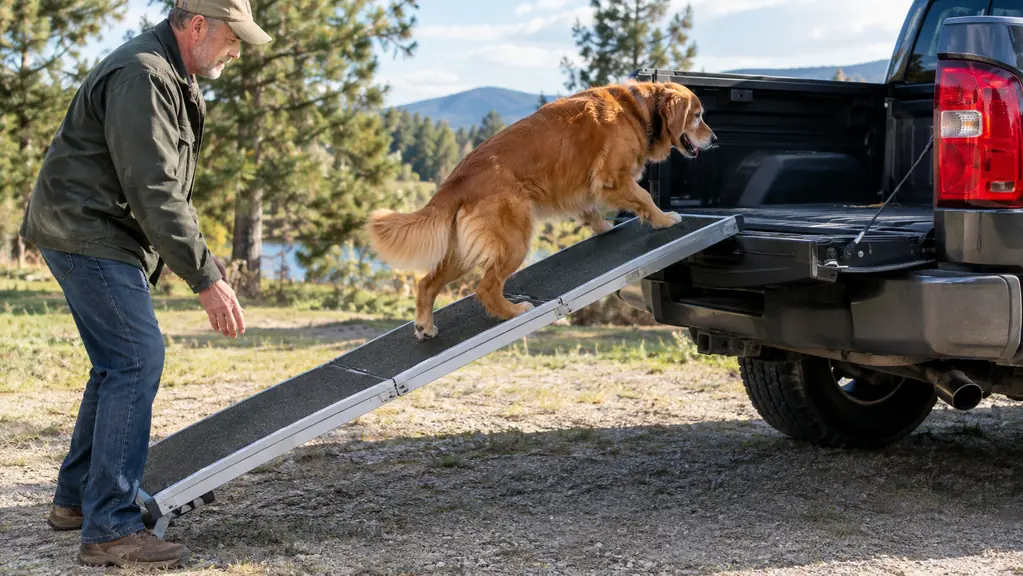
Once Murphy would step onto the ramp on flat ground, I started making it the best spot in the yard. I fed him his breakfast on it, kibble scattered along the surface so he had to stand on the ramp to eat. I sat down next to it and gave him attention while he was on it. When the grandkids were over, I let them toss treats onto the ramp too, so Murphy learned that kids and the ramp both meant good things. The ramp became the place where good things happened.
I also taught him a marker word during this step. Every time his paws touched the ramp, I said 'yes' and dropped a treat. Within a few days, the word 'yes' meant a reward was coming, and Murphy started stepping on the ramp just to hear it. You can use a clicker if that is what you already use with your dog. The word works just as well. The marker word only works if you say it the same way every time, so I kept mine short and happy.
Keep these sessions short. Five minutes of happy training beats twenty minutes of a bored dog walking away. I made the mistake of dragging one session out until Murphy wandered off mid-treat, and it set us back a day. When he is still eager, that is the time to stop. And never chase a dog who walks away. Chasing turns the ramp into a game of keep away, and you will start over from scratch.
Step 3: Practice walking across on flat ground until it is boring
The key to this whole process is repetition until the ramp is boring. We walked across the ramp on flat ground several times a day, but only a few minutes at a time. Murphy would trot across, get his treat, and trot back. We practiced both directions, too, so the ramp never became a one-way trip. A tired dog does not learn, so we practiced in the morning before the heat set in. No drama, no height, just practice.
I always ended a session after a success, never after a frustration. If Murphy balked, I simply waited, let him come to the ramp on his own, and ended the moment he did it right. It took about a week before he would cross the ramp on flat ground without looking up at me for permission. That is exactly what you want: a dog who treats the ramp like it is part of the lawn. The week felt long at the time, but it was the foundation for everything that came after.
During this step I added a little command so the ramp was not just a random object in the grass. Every time Murphy stepped on, I said 'up' in a cheerful voice. Pretty soon he would wait at one end, look at me, and step on when he heard the word. You do not need a command, but it helped us later at the truck when I needed him to go up on cue.
Step 4: Raise one end a few inches at a time
Once flat ground was boring, I raised one end of the PetSafe Happy Ride onto the bottom step of our porch. Just a few inches, barely a slope. Murphy balked at first, so I sat at the low end with a handful of treats and let him figure out that the ramp was steady. Sturdy matters with a 78 pound dog. He can feel a wobbly surface a mile away, and he will not trust it. I also kept the first few sessions short, just three or four crossings, so the new height never turned into a big deal.
I learned two things here. First, keep the angle gentle. A ramp set too steep is just a skinny staircase to a senior dog, and it defeats the whole purpose of protecting those hips and elbows. Second, give him a day or two at each new height. I was in a hurry to get to the truck, and every time I rushed the angle, Murphy voted no with his feet.
If you do not have a porch step, a thick book or a block of wood works to start. The point is a very small change, not a real slope. We spent three days going from the porch step to a second step, which is still nowhere near tailgate height. Each time I raised it, I went back to the treats on the surface for the first few tries, then faded them out once he was comfortable. Slow felt like it was taking forever. Looking back, it was the fastest part of the whole process.
Step 5: Move to the truck and take the first ride
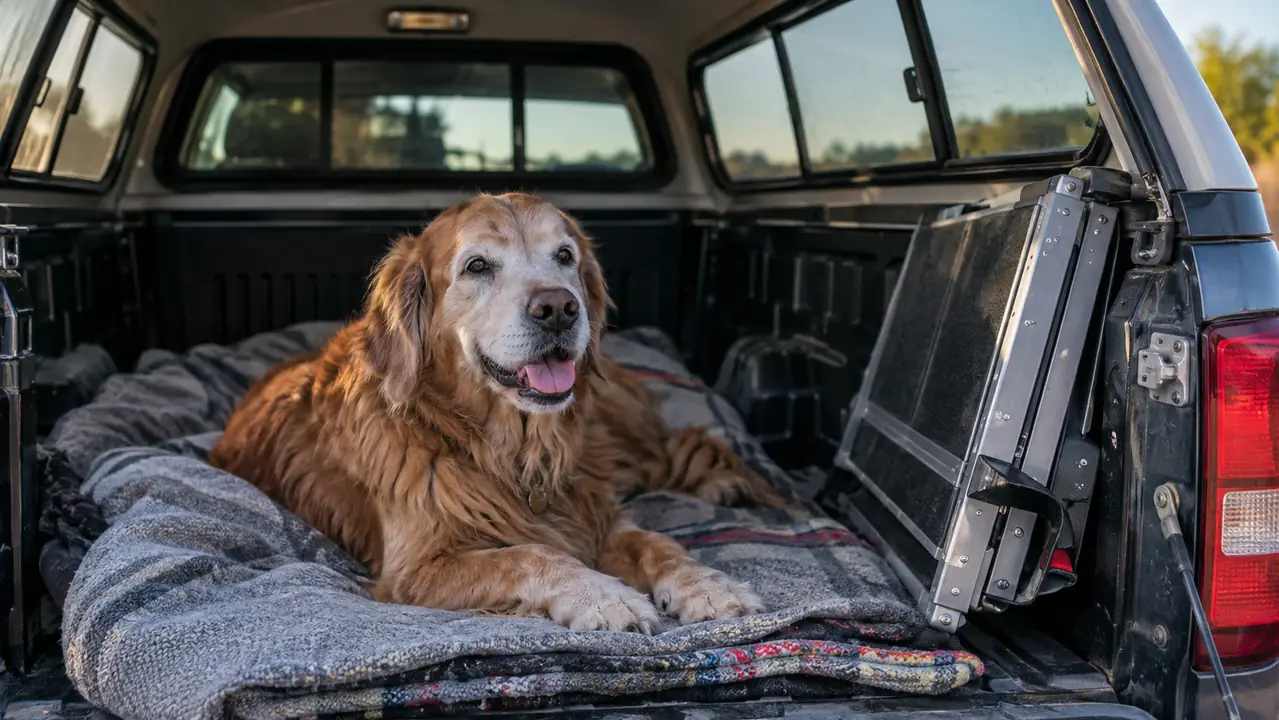
The real test was the tailgate. I set the ramp up at the truck and let Murphy walk up and down a few times with the tailgate down and the camper shell open so he could see the whole bed. I kept my hand near his collar on the first few climbs, not to pull him, just so he knew I was there. Then I put his favorite blanket in the back, walked him up, gave him a treat, and just sat with him in the truck bed for a few minutes. We did not drive anywhere the first two times. We just made the truck a nice place to be.
After that, we took a short drive to the end of the driveway and back. Then a loop around the block. Now Murphy walks the ramp without hesitation, and he rides with his head out the side like he is five years old again. It took about two weeks from the first sniff to the first real ride, and most of that time was me learning to be patient. The first time he walked up on his own at the tailgate, I nearly cried, and I am not ashamed to admit it.
One thing I would do differently: I would set the ramp at the tailgate even on days we were not going anywhere, and let Murphy walk up and down it for fun. We only practiced at the truck when we were about to drive, and that made the ramp mean 'the vet' or 'the lake' instead of just being a ramp. A few no-destination practice sessions would have saved us some nerves. Every dog is different, so take the time your dog needs.
What Else Helps
A ramp does not fix everything, and I do not want to pretend it does. Talk to your vet about Murphy's stiffness before you change anything about how he gets in and out of the truck. Our vet is the one who suggested we stop letting him jump at all, and that advice probably saved him from a lot more pain. Keep his nails trimmed too. Long nails slip on a ramp surface, and a senior dog who slips once may not trust the ramp again. A ramp is not a substitute for veterinary care, and it will not undo years of jumping. It just takes the worst of the impact away. If the stiffness gets suddenly worse, call your vet. That is not a ramp problem, that is a medical one.
On bad mornings, when Murphy is stiffest, I still help him. We use the ramp at its lowest angle, and I stay right beside him with a hand under his chest. A short warm-up walk around the yard before he has to climb also helps. Five minutes of slow walking loosens him up more than you would think. The same patience applies at the boat, where Murphy hesitates at the ladder some mornings. I do not push him there either. We wait, and usually he decides on his own.
If you are weighing a ramp against dog stairs, or you want to understand how a ramp protects a senior dog's joints as they age, those are worth reading before you buy. And if you want the long-term picture of how the PetSafe Happy Ride held up through a summer of weekends at the lake, the long-term review covers that.
It took Murphy about two weeks to go from sniffing the ramp in the grass to riding in the truck, and the whole thing started with one treat on flat ground.
Give your senior dog a gentle way into the truck
The PetSafe Happy Ride folding ramp is the ramp we used for every step of this plan. It folds flat for storage in the camper shell, and it gives a stiff older dog a steady slope instead of a jump.
Amazon Check Today's Price on Amazon →