
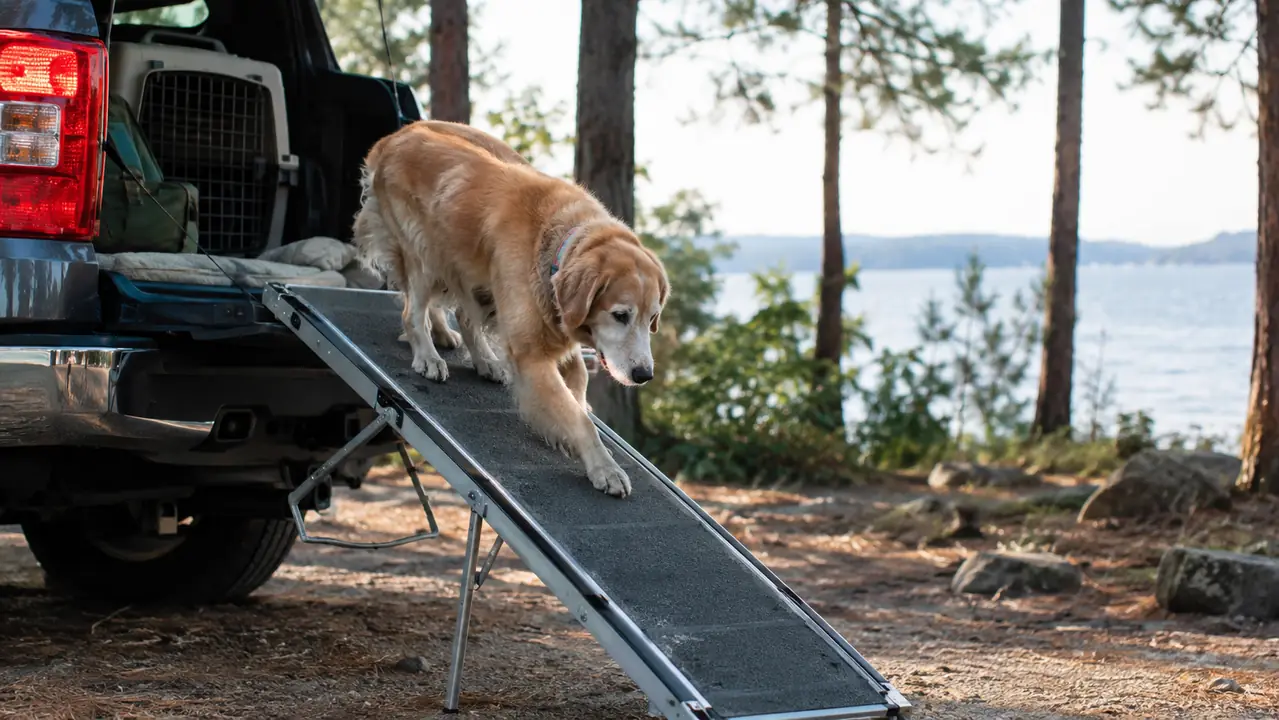
Murphy used to clear the tailgate of our pickup in one leap. At seventy-eight pounds and twelve years old, that leap went from a habit to a risk somewhere between last fall and this spring. Our vet said what I already suspected: landing from that height, over and over, is exactly the kind of impact that makes a stiff old dog stiffer. So I started looking at ramps, and the PetSafe Happy Ride folding dog ramp is the one that has lived in the bed of our truck all season. I have wanted to write this review for a while, because the short version is that it worked, and the long version has a few honest caveats that are worth knowing before you buy.
The truck is only half the story. Murphy has spent every summer of his life swimming off our pontoon boat, and this year the boat ladder got harder for him. He would swim over, paddle in circles, and then just float there looking at the ladder until one of us reached down to help. Between the tailgate in the morning and the dock in the afternoon, I realized we needed a way for him to get up and down without jumping, and without Ray and me trying to lift a stiff, heavy dog every single time. The ramp was supposed to be the answer. After a full season of weekends at the lake and one long July trip, here is what I can tell you honestly.
The Quick Verdict
A sturdy folding ramp that gave my stiff senior Lab his independence back at the tailgate and the dock. It took a few weeks of training and it is not a set-and-forget tool, but it earned its spot in the truck.
Amazon Check Today's Price →Give a stiff old dog a walk instead of a leap.
The PetSafe Happy Ride folds flat, stores in the truck bed, and gives a senior dog a gentle slope instead of a jump from the tailgate. It worked for Murphy's hips and elbows all season. Check today's price on Amazon and see if it fits your vehicle.
Amazon Check Today's Price on Amazon →How I've Used It
The ramp has been in regular use since early June, which means most weekends plus a week-long trip in July. Murphy uses it three or four times a day on a camping weekend: up into the truck bed in the morning, down again when we reach the lake, and again for the ride home. I also use it for the car when I take him to the vet by myself, because the car sits lower than the truck and he still hesitates at that door. We keep it folded in the bed of the pickup, leaned against the camper shell, and it takes me about a minute to set it up.
The setup is simple enough that I do it without thinking now. The ramp has a hinge in the middle, so it folds in half for storage and locks open for use. You rest the top edge on the tailgate or the car door sill, let the bottom sit on the ground, and it stays put while the dog walks. There are no tools, no straps to fiddle with, and no reason to wake Ray up to help. For a sixty-three-year-old grandmother with a shoulder that complains, that matters more than I can tell you.
Our routine got consistent fast. Murphy rides with a bed and a bowl of water in the back, and the ramp is part of loading him in, not an extra chore. On the days we are not camping, the ramp still comes out when he needs to get into the car for a vet visit or a ride to my daughter's place. It is not a piece of gear that sits in the garage waiting for a special occasion. It is part of how we move Murphy around now, the same way his bed and his slow morning walks are part of how we take care of him.
Why the Tailgate Was the Problem
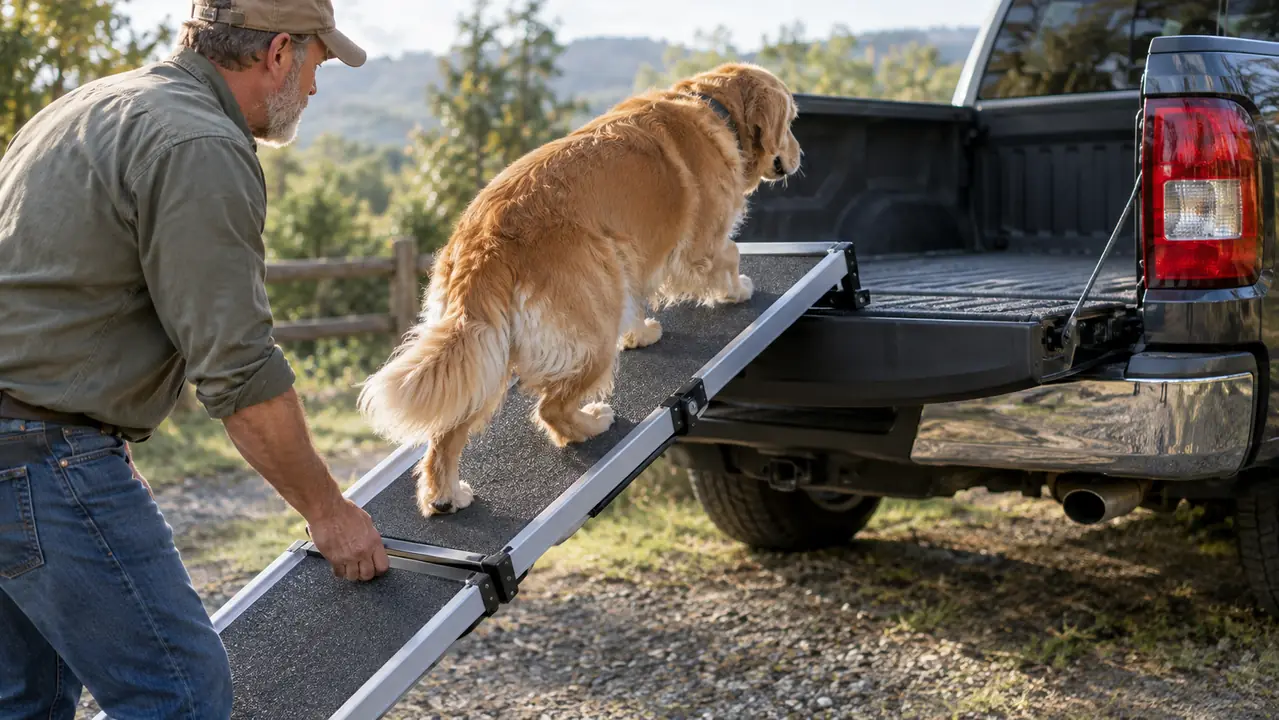
A dog Murphy's size does not just hop down from a pickup tailgate. He launches. The front legs take the first impact, then the back legs land a half second later, and all of that force goes straight through the elbows and hips. Over a summer of daily trips, that adds up in a hurry. Our vet was blunt about it: repeated jumping is one of the hardest things on an older dog's joints, and the higher the drop, the worse it is. That is why the tailgate was the first place I wanted to fix.
Before the ramp, we tried a few things. I lifted him in and out of the truck, which worked until he got too heavy and my back reminded me why that was a bad plan. We tried a set of pet stairs, and Murphy looked at them like I had lost my mind. He would use them at home for the bed, but at the tailgate he would rather wait for someone to lift him. If you are weighing a ramp against stairs for your own dog, that comparison is worth a read before you spend money, because the two solve the same problem in different ways.
The ramp changes the math. Instead of a drop of two and a half feet, Murphy walks down a slope that is long enough to be gentle. His hips and elbows still do the work, but they do it the way they were built to, with the joints moving through their normal range instead of slamming into a landing. For a dog with hip and elbow stiffness, that is the whole reason to buy a ramp. There is a longer list of reasons a ramp protects a senior dog's joints, but the short version is this: walking beats jumping, every time.
Teaching an Old Dog a New Step
I will not pretend Murphy walked up the ramp the first time. He did not. A twelve-year-old dog who has spent his whole life jumping into trucks does not instantly trust a piece of gear that moves under his feet. The first two times I set it up, he stood at the bottom, sniffed it, and looked at me like I was asking him to walk the plank. I had to go back to basics and remind myself that he is an old dog who has earned the right to be skeptical.
What worked was breaking it into tiny steps. Day one, I put the ramp flat on the ground and walked him across it a few times with a treat at the end so he learned that it was solid under his feet. Day two, I propped the bottom edge on a low curb so it had a slight angle. By the end of the first weekend, he would walk up it into the truck bed if I stood on the other side with a piece of cheese. The second weekend, he did it without the cheese. The third weekend, he did it before I even asked. That is the whole training plan, and it worked.
The lesson I would pass along is to be patient and keep the sessions short. A stiff old dog gets frustrated fast, and the last thing you want is to turn the ramp into a fight. Five minutes of practice, a pocketful of treats, and a lot of praise got us there. If your dog is younger and more confident, it will go faster. If your dog is as set in his ways as Murphy, give it two full weeks before you decide whether the ramp is going to work for you.
A Season of Use: What Held Up and What Didn't
After a full season, the ramp itself has held up well. The hinge still locks firmly, the surface still gives Murphy's feet traction, and it has been rained on, baked in the sun, and bounced around in the truck bed without coming apart. The non-slip surface was the feature I was most worried about, because wet dog feet and a wet ramp sounded like a bad combination. In practice it has been fine, including the morning after a thunderstorm when everything was damp and Murphy needed to get into the truck for his vet appointment.
The honest part is that this is not a tool you can set up and ignore. The ramp needs to be positioned so the top edge sits solidly on the tailgate, and the angle is different on a truck than it is on a car. I also do not let Murphy use it unsupervised. He is steady on it now, but he is still an old dog on a slope, and I would rather be two steps away than in the house when he comes down. That is not a criticism of the ramp. It is just the reality of using one with a senior dog.
Storage is a small tradeoff. Folded, the ramp is still a long, flat piece of gear, and it takes up a corner of the truck bed. It is not heavy enough to be a problem for me to move, but it is not something you will forget is back there. For us, that is a fair price for knowing Murphy can get in and out of the truck without jumping. For someone with a small car and no room to store it, the folded size might be a bigger deal, and it is worth measuring your space before you order.
One more thing I noticed: the ramp does not fix every joint problem, and I do not want anyone to think it does. Murphy still gets stiff in the morning, and he still hesitates at the stairs in the house. The ramp took care of the truck and the car, which were the two places he was jumping, and that is a real win. The rest of his joint care is a conversation with our vet, and the ramp is one tool in that conversation, not the whole answer. Anyone who promises a ramp will cure a stiff old dog is overselling it.
Where It Helped Beyond the Truck
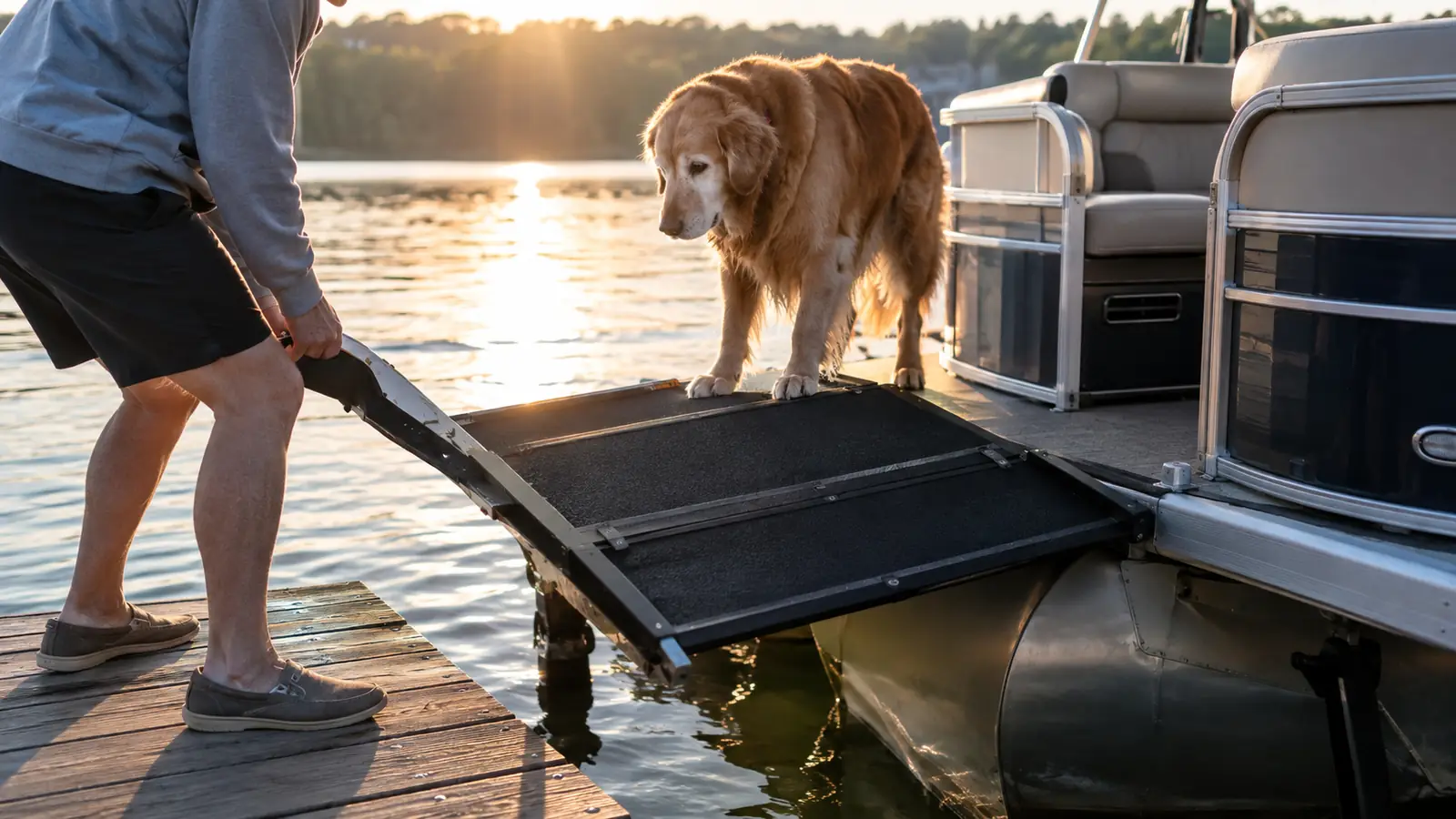
The surprise of the season was the dock. Murphy swims out to the pontoon boat and back the way he always has, but getting from the swim platform up to the dock got harder for him this year. The platform sits lower than the dock, and that little step up turned into a hesitation. On a whim, Ray set the ramp up on the dock edge, holding it steady while Murphy walked up. It worked. We used it that way for the rest of the summer, always with one of us right there, and it turned a moment of dread into a normal part of the day.
It also helped with my daughter's SUV. When she takes Murphy for a weekend, she had been lifting him into the back, which neither of them loved. The ramp fits her vehicle fine, and now Murphy gets in and out of her car the same way he gets in and out of ours. One ramp, three different places it has been genuinely useful over the course of a summer. That is more than I expected when I bought it, and it is the main reason I would recommend it to someone whose dog goes more than one place.
What I Liked
- Gives a stiff senior dog a walk instead of a leap, which is easier on hips and elbows
- Folds in half and stores easily in the truck bed
- Light enough for a 63-year-old grandmother to set up on her own
- Non-slip surface held up through a wet summer at the lake
- Worked for the truck tailgate, the car, and the dock edge
Where It Falls Short
- Murphy needed two patient weeks of training before he trusted it
- You still need to supervise; it is not a set-and-forget tool
- Folded size takes up a corner of the truck bed
- The slope is still a slope, and a very stiff dog may still need help
- It solves the jumping problem, not every joint problem
By the fourth weekend, Murphy was walking up the ramp on his own, no cheese in sight, and that was the moment I stopped worrying about his hips on every single trip.
Who This Is For
The PetSafe Happy Ride is for anyone with a dog who still wants to go places but is starting to find the getting in and out harder than the going. It is for the person who is tired of lifting a heavy dog into the car, and for the dog who would rather wait at the tailgate than jump. If your dog is stiff but still steady on his feet, and you have a little patience for a few weeks of training, this ramp will probably earn its keep in your vehicle the way it did in ours. It is also for people who, like me, want to keep their dog's joints healthy as long as possible, because every jump you remove is one less impact on an aging body.
Who Should Skip It
Skip it if your dog refuses to walk on a slope no matter how many treats you offer, because some dogs simply will not take to a ramp. Skip it if you need a solution for a dog who cannot bear weight on a leg at all, because a ramp still requires the dog to walk. Skip it if you have no place to store a long folded ramp, because it takes up more room than a set of stairs. And if your dog is young and healthy and still jumping in and out without a care, you may not need it yet. For any of those situations, talk to our vet or your own before you spend the money.
The Bottom Line
A season in, I would buy the PetSafe Happy Ride again. It is not a magic wand and it is not a cure, but it does exactly what I bought it to do: it gives Murphy a way to get in and out of the truck and the car without jumping, and it gave him back a little of the independence that stiffness was taking away. It is one of the most popular folding ramps on Amazon, with more than fifteen thousand reviews, and after a season of use I understand why. The training took patience, the storage takes room, and you still have to supervise. But watching an old dog walk down a ramp instead of launching himself off a tailgate is worth every bit of that.
A season in, this ramp still earns its spot in the truck.
If your senior dog hesitates at the tailgate the way Murphy did, the PetSafe Happy Ride is worth a look. Check today's price on Amazon and see if it fits your vehicle and your dog.
Amazon Check Today's Price on Amazon →