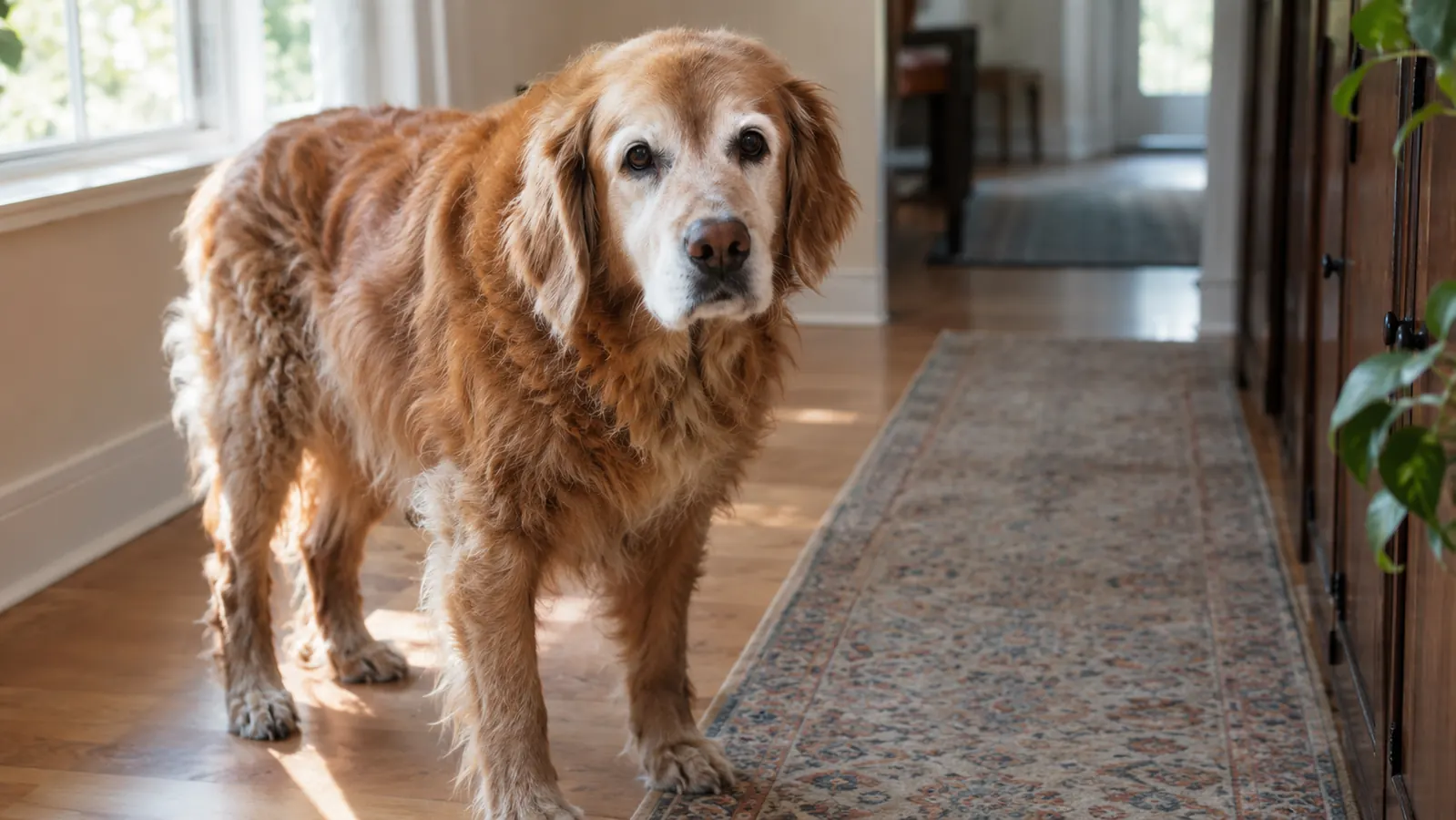
It started as a small thing. Murphy would walk across our hardwood floor, his back feet would slide out from under him, and he would land with a thud. At 12 years old and 78 pounds, a yellow Lab does not bounce back the way a puppy does. The first time it happened, I stood there trying to figure out what to change. We had lived in this two-story house with hardwood floors for years, and Murphy had never had trouble before. Age changed that. His hips and elbows are stiff now, and he is slower getting up in the morning. When his feet slip, he cannot catch himself the way he used to. I tried a few things on my own before I found what worked. A friend at the campground mentioned DOK TigerToes non-slip dog socks, and after a week of using them, I understood why they had so many reviews. This is the order I would do things if I were starting over.
Murphy is a 12-year-old yellow Lab, about 78 pounds, and he has spent his whole life swimming off our pontoon boat. His hips and elbows are stiff now, and he is slow to get up in the morning. Watching him slide on the floor is scary, because a fall for an older dog can turn into a much bigger problem. I wanted to fix it before he hurt himself.
The DOK TigerToes socks that gave Murphy traction on our hardwood
DOK TigerToes have extra-thick grip dots on the bottom that hold even when the sock twists, and they stay on better than any sock we tried. They are not a replacement for rugs or nail care, but they are the single most useful thing we added for Murphy's back feet.
Amazon Check Today's Price on Amazon →What Worked for Us
I want to be clear about one thing before I walk you through the steps. There is no single fix that stopped Murphy from slipping. What worked was doing several small things together, in the right order, and giving him time to adjust. The order matters more than you might think. Nail care and floor surfaces cost almost nothing and help right away. The DOK TigerToes helped the most on the worst spots. And the exercises are the part that will help him months from now. Here is exactly what we do.
Step 1: Keep His Nails Short and the Hair Between His Toes Trimmed
The cheapest fix is the one most people skip. Long nails lift the paw up at the toe, so the pad does not touch the floor the way it should. On hardwood, that means less surface area gripping and more sliding. Murphy's nails grow fast for a dog his age, so I trim them every two to three weeks. Our vet showed me how to do it at home: cut small amounts, avoid the quick, and file the rough edge with a nail file made for dogs.
The hair between the toes matters just as much. When that hair gets long, it mats under the paw and turns the whole foot into a little ski. I use rounded scissors and trim the hair flush with the pad. It took me about ten minutes the first time. Now it is part of our Sunday routine. If you have never trimmed a dog's nails, ask your vet or a groomer to show you once. It is a skill worth having.
One more note about nail care. I trim Murphy's nails after a bath or a swim, when the nail is softer and easier to cut. I keep a small container of styptic powder in the drawer just in case, though I have only needed it once. If you nick the quick, do not panic. A little powder, a little pressure, and it stops. The important thing is to make it a routine, because long nails are the reason many dogs start slipping in the first place.
Step 2: Put Down Runners and Rugs With Non-Slip Backing
You do not have to rip out your floors. You just need to give the dog a path that does not turn into an ice rink. We bought a few long runner rugs with rubber backing and laid them down the middle of the hallway and across the kitchen. The rubber backing keeps the rug from sliding when Murphy steps on it. A rug that slides is worse than no rug, because the dog is standing on something that moves under him.
I also put a smaller mat in front of the back door and another at the bottom of the stairs. Those are the two spots where Murphy turns around, and turning is when he loses his footing. The mats do not need to be fancy. They need to be wide enough for him to turn on and heavy enough to stay put. We wash them in the machine once a week. It takes five minutes.
If you are not ready to buy runners, try the cheapest thing first: a bath mat with a rubber back, laid flat on the floor in the spot where your dog slips most. We tested one in front of the couch before we bought the runners. It stayed put, it washed easily, and it showed us which spots needed the most coverage. Sometimes one mat in the right place is enough.
Step 3: Put DOK TigerToes on His Back Feet for the Slippery Spots
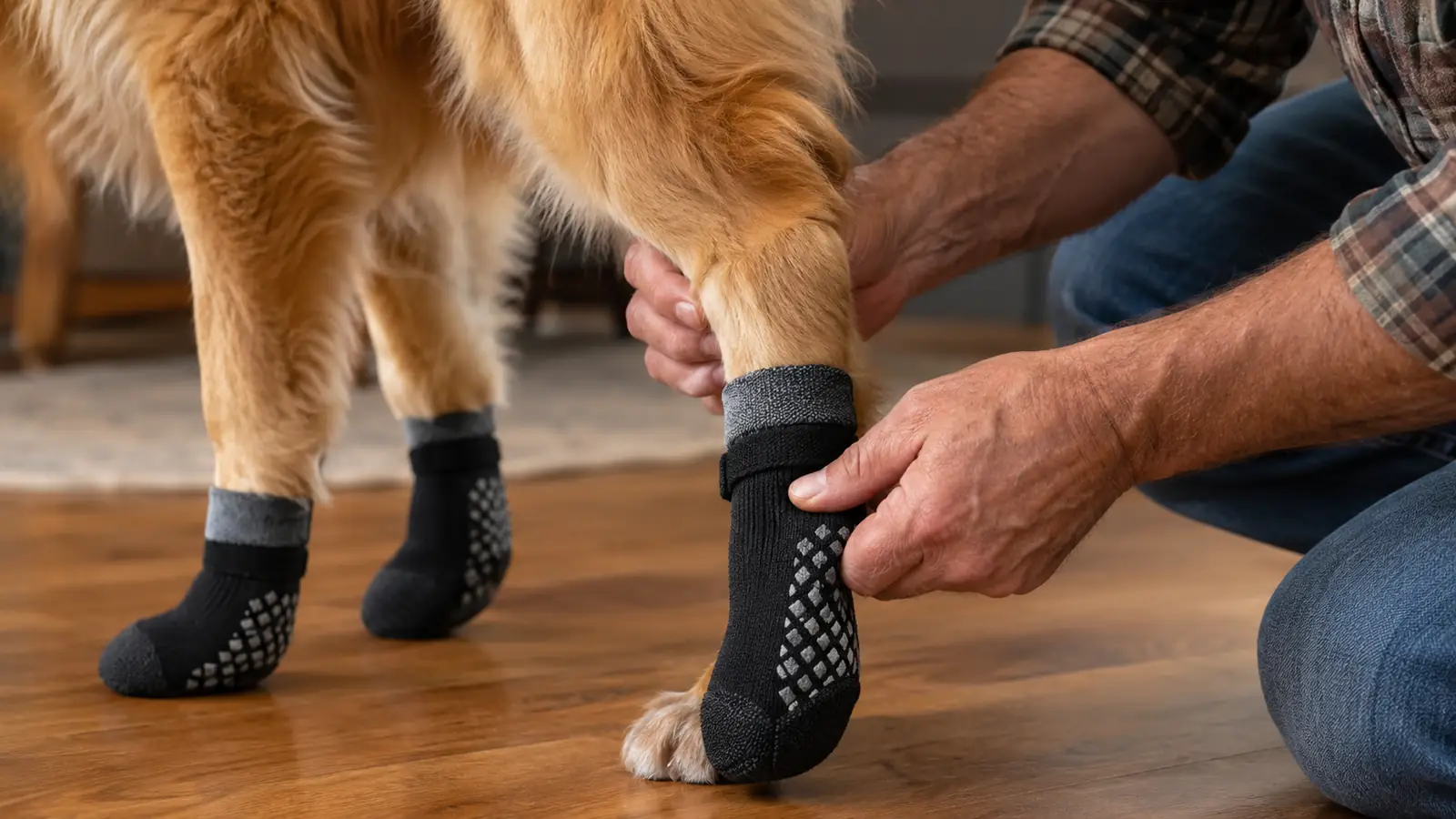
This is the step that made the biggest difference for us. DOK TigerToes are socks with thick grip on the bottom, and they are made for dogs who slide on smooth floors. We use the X-Large size on Murphy's back feet. His front feet rarely slide, but his back feet are the ones that give out when he is trying to stand up from a lying position. Putting them on is easy: I slide the sock over his paw, make sure his toes are spread inside, and pull the cuff up over his ankle. The grip works even when the sock twists, which matters because Murphy likes to kick his feet when he first stands.
The first morning we tried them, Murphy walked from the kitchen to the back door without his back feet sliding out from under him. I nearly cried. He still moved slowly, but he moved with confidence. We now put DOK TigerToes on him every morning and take them off when we go outside, because they are not outdoor shoes. They are an indoor traction aid, and they work best on hardwood, tile, and laminate.
A few honest notes. DOK TigerToes do not fix the underlying stiffness in his hips, and they do not replace a trip to the vet. They also do not help on wet floors. If Murphy steps in a puddle by the back door, the socks get damp and lose grip, so I wipe his feet or take them off before he walks across the kitchen. And I check his toes every time I take the socks off to make sure nothing is rubbing. We have had no problems, but it takes ten seconds.
Step 4: Make the Stairs and Doorways Safer
The stairs are the scariest part of our house for Murphy. He can climb them, but he hesitates at the bottom, and I could see him thinking about every step. We put stair treads with a gritty surface on each step. They give his feet something to catch, and they also give me peace of mind when I am carrying laundry up and down. The treads cost less than a trip to the store and took about an hour to install.
We also changed how we use the back door. Murphy used to bolt out when he heard the latch, and that is exactly when he would slip on the smooth floor by the door. Now I make him wait until I open the door all the way and say his name. It sounds small, but slowing him down at the doorway means his feet are under him when he steps onto the concrete. If your dog is excited at doors, try teaching a short wait before you open it.
One more thing about the stairs. We taught Murphy to wait at the top and bottom until one of us is close. He used to try to follow Ray downstairs the moment Ray started moving, and that is when he would hesitate and lose his balance. Now we say 'wait' and he looks back at us before he starts down. It is not a fancy trick. It is just a way to make sure he is paying attention to his feet.
Step 5: Strengthen His Hind End and Talk to Your Vet
Traction helps, but the real problem is that Murphy's back legs are not as strong as they used to be. Our vet said the best thing we can do is keep him moving and build the muscles that support his hips. We do a few simple exercises every day. He does a sit-to-stand from a lying position, which works his back legs. We also do slow, short walks on flat ground, and he swims in the lake when the weather allows. Swimming is the one exercise he still asks for.
We also talked to our vet about his joints. After an exam, our vet suggested a joint supplement and a daily routine that works for Murphy's age and weight. I am not going to tell you that any supplement fixed him overnight, because it did not. What helped was the combination: shorter nails, grippy floors, DOK TigerToes on his back feet, and gentle exercise every day. If your dog is suddenly slipping more than usual, or if he seems painful, please call your vet before you buy anything. Sudden changes can mean something more serious.
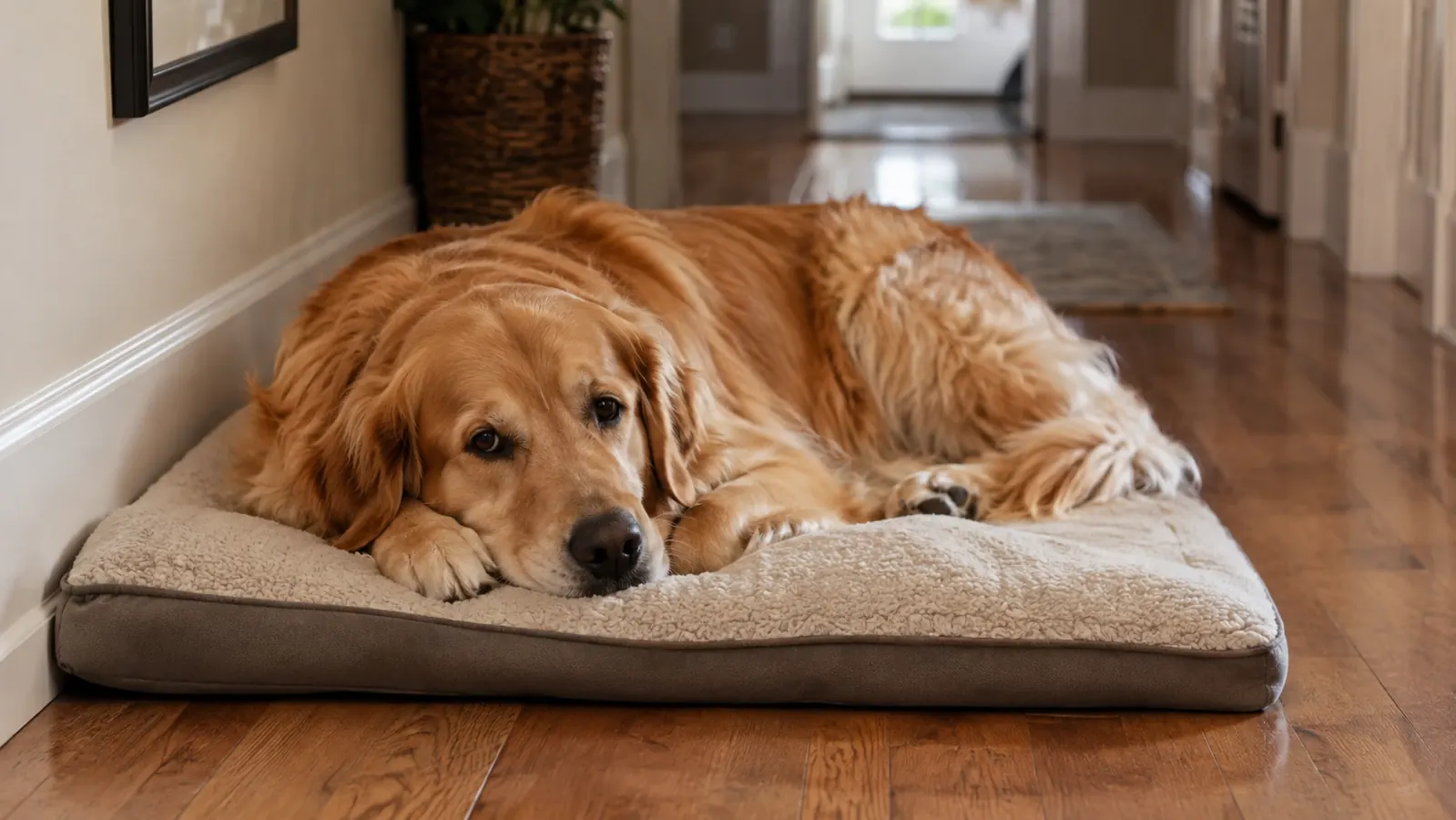
I also learned to watch his body language. When Murphy is having a stiff morning, he stands with his back feet wider apart and he takes a few seconds before he moves. On those mornings, I shorten his walk and I let him set the pace. Pushing him to go further never helped. Gentle movement, a warm towel on his hips after a swim, and a quiet place to rest have done more for him than any single product.
What Else Helps
A few extras made life easier. A rear support harness takes weight off Murphy's back legs when he needs to get up from the floor or climb into the truck. I keep one by the back door for the days when his hips are stiff. We also watch his weight closely, because every extra pound is more work for those back legs. And I stopped expecting him to move like he did five years ago. Some mornings he is slow. That is okay. Slow is not the same as hurting, and our vet is the one who helps us tell the difference.
You might be wondering if socks alone are enough. For us, they were not. Murphy still needs his nails trimmed and his path cleared, and he still needs the exercises that keep his back legs strong. The socks are the part that made the biggest difference on the floor, but they work best as part of the whole routine. If you only do one thing, start with the floor. If you can do two, add the socks.
One last thing: be patient. It took Murphy a few days to trust the socks and the new rugs. He would stop and stare at the runner before he stepped on it. Now he walks across without a second thought. Give your dog time to learn the new surfaces, and celebrate the small wins. The morning he walked from the kitchen to the back door without sliding, I knew we were on the right track.
The first morning Murphy walked from the kitchen to the back door without his back feet sliding out from under him, I nearly cried.
Try the cheap fixes first, then add DOK TigerToes
Start with nail trims and runners, then add DOK TigerToes for the spots that are still slick. They are easy to put on, easy to wash, and they gave Murphy back his confidence on our floors.
Amazon Check Today's Price on Amazon →