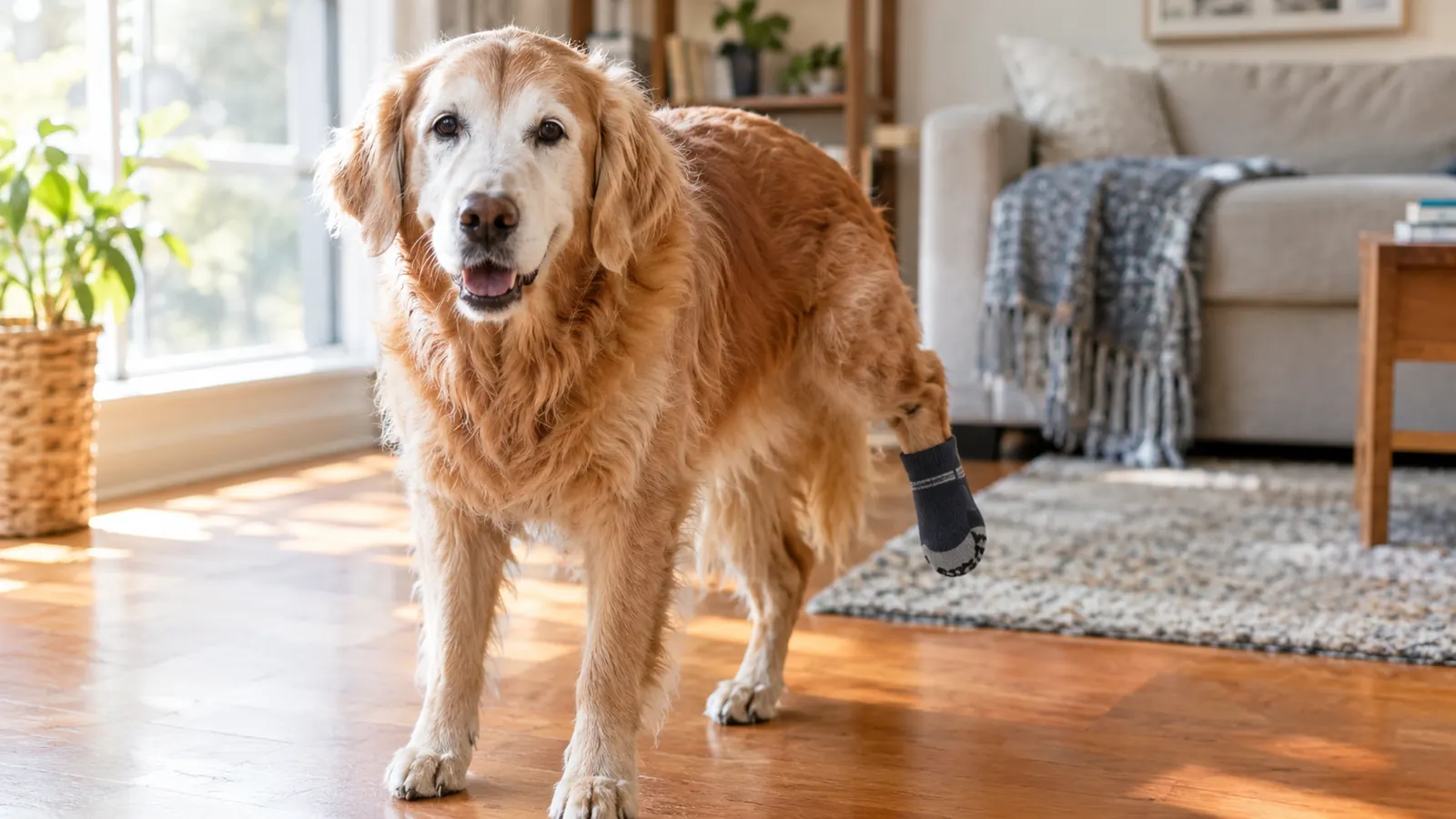
Murphy is a 12-year-old yellow Lab, about 78 pounds, with hips and elbows that have gotten stiff over the last couple of years. Our house has hardwood floors on the whole main level and a staircase up to the bedrooms. Last winter I watched him round the corner from the kitchen onto the hardwood, and his back feet went out from under him like he was on ice. He caught himself, but I could see the fear in his face. That was the day I started looking for dog socks that actually grip.
I ordered the DOK TigerToes Premium Non-Slip Dog Socks in X-Large. They have been on Murphy's back feet almost every day since, through a whole winter and into spring. This is the long-term review I wish I had found before I bought them.
The Quick Verdict
The best grip socks I tried for a senior dog on hardwood, and they survived months of daily wear, but the fit is finicky and they are not a fix for every dog.
Amazon Check Today's Price →If your dog slides on hardwood, start here
DOK TigerToes are the socks that finally gave Murphy traction on our floors. See today's price and sizing on Amazon.
Amazon Check Today's Price on Amazon →How I've Used It
Murphy wears the DOK socks on his back paws only. That is where his slipping was worst, and where his hip stiffness makes him least able to catch himself. He wears them from about 7 in the morning until bedtime, which works out to roughly 12 hours a day. He does not wear them outside, because we go out through the mudroom and I did not want to test how they handle gravel.
I ordered them in the middle of November, the same week Murphy slid in the kitchen, and they arrived on a Tuesday. The package sat on the bench in the mudroom for a day before I opened it, because I wanted to read the sizing chart one more time. I put them on him that same afternoon, and the first thing he did was stand in the middle of the living room and stare at his feet. For the first few minutes he walked stiff-legged, lifting each paw high like he was stepping through snow. By dinner he had forgotten they were there. By day three he was walking normally, and by the end of the first week he would lift each back paw for me when I held the sock out.
The routine is simple. I keep both pairs in a basket in the mudroom next to his leash, and I put them on before he comes down the stairs in the morning. Ray helps on cold mornings when Murphy is slowest to get up. We take them off after his last trip out at night, and he gets a biscuit for standing still during both. The brand says the socks prevent licking and protect paws, and I can confirm the licking part: Murphy used to chew at his front paws in the evenings until they were damp and sore-looking, and that stopped almost immediately. That was a side benefit I did not expect.
On the worst mornings, when Murphy's hips are stiffest, he stays lying down until Ray has the coffee going. I bring the socks to him and he lets me put them on while he is still on his bed. That is the other thing I learned: put them on before he stands up, not after. If he is already standing on the hardwood, he is tense and harder to work with. On the bed, he is relaxed and lifts each paw without being asked. It takes me about a minute to get both socks on now, where it took five the first week.
I wash them every three or four days in a mesh laundry bag on the gentle cycle with cold water, then lay them flat to dry on the rack in the laundry room. That has mattered. The first time I dried them in the machine, the elastic around the cuff felt a little looser when I took them out. Since I switched to air drying, they have held their shape. I also bought a second pair about a month in, so each pair gets a day off and the washing stays manageable.
How the Grip Holds Up on Hardwood
The whole reason I bought the DOK socks was the grip, so that is what I watched most closely. The bottom of each sock is covered in a thick rubbery pattern, and the brand calls it TigerToes because of the little toe-shaped nubs. On our floors, the difference was immediate. Murphy went from sliding when he turned to walking with confidence, and I stopped holding my breath every time he rounded the corner from the rug onto the wood.
Before I ordered the socks, I tried two other things. First I trimmed Murphy's nails shorter, because long nails make a dog's feet slide more on wood. That helped a little but not enough, and it made him fussy about having his feet handled. Then I laid down a runner rug along the hallway and another at the bottom of the stairs. Those helped, but Ray tripped on the hallway runner twice, and Murphy started walking around the rugs instead of over them, which put him right back on the bare wood. The socks were the only fix that did not change the house around the dog.
The corner I was most worried about is the one from the kitchen into the hall. It is a tight turn, and Murphy has to plant his back feet and pivot to make it. That is the exact move that put him on the floor last winter. With the socks on, he takes that corner at a normal walk. I have watched him do it a hundred times since November, and his back feet have not slid once. One morning in January I left the socks off while I ran to the mudroom to grab his leash, and in the thirty seconds I was gone he rounded that same corner and his back feet went out again. He caught himself, but it told me exactly how much of the work the socks were doing.
The grip has lasted, too. After months of daily wear and regular washing, the nubs on the bottom are still there. They have flattened a little on the part of the sock that takes the most weight, which is the back of the paw where Murphy pushes off, but they still grip. I tested this by putting one sock on his paw and pressing down on his foot. On the bare floor, his foot slid easily. With the sock, I could feel the rubber bite into the wood. I also tried twisting the sock the way the brand says you can, and the grip did still work, though a twisted sock bunches between his toes and makes him walk funny, so I fix it when I see it.
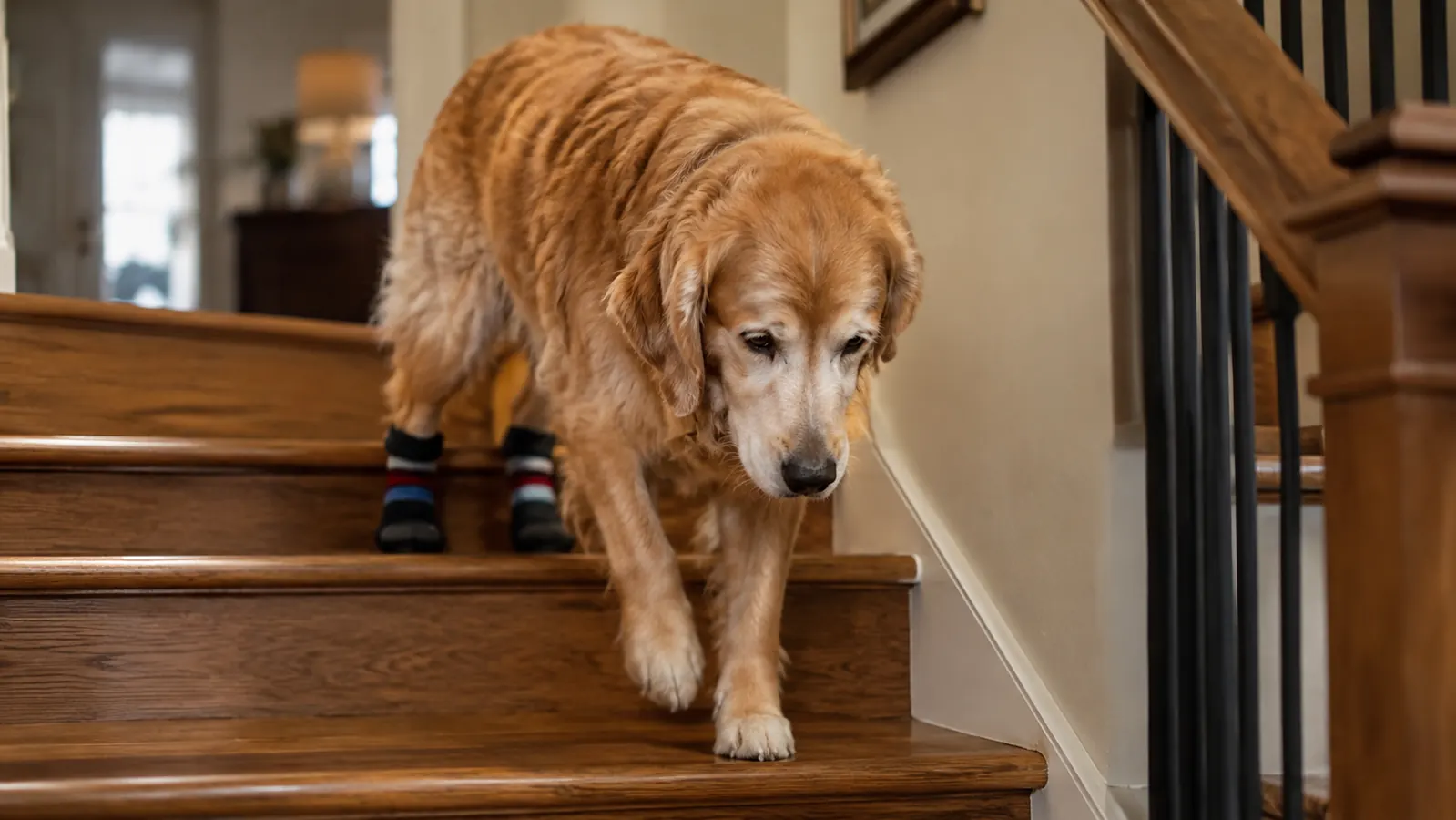
The stairs are where I saw the biggest change in his confidence. Before the socks, Murphy would stand at the top of the stairs and whine until one of us came to walk down with him. Now he comes down on his own, slowly, one paw at a time, but he comes down. He still hesitates at the top some mornings when his hips are stiff, and I do not rush him. The socks help a lot, but they do not turn a stiff old dog into a puppy. If your dog is already unsteady, do not expect a sock to fix that. Expect it to give them a better chance, which is exactly what it did for Murphy.
Fit, Sizing, and the Learning Curve
The DOK TigerToes come in sizes from small up to X-Large, and the sizing chart is based on paw width and length. I measured Murphy's paws with a cloth tape measure while he was lying down, the way the chart shows. His front paw is right at 4 inches wide, and his back paw is a little narrower, about three and three-quarter inches. That is normal, by the way. A lot of dogs have back paws that are narrower than their front paws. The chart put him at X-Large for the front and right at the edge of Large for the back, and I ordered X-Large so he would have room in the toe.
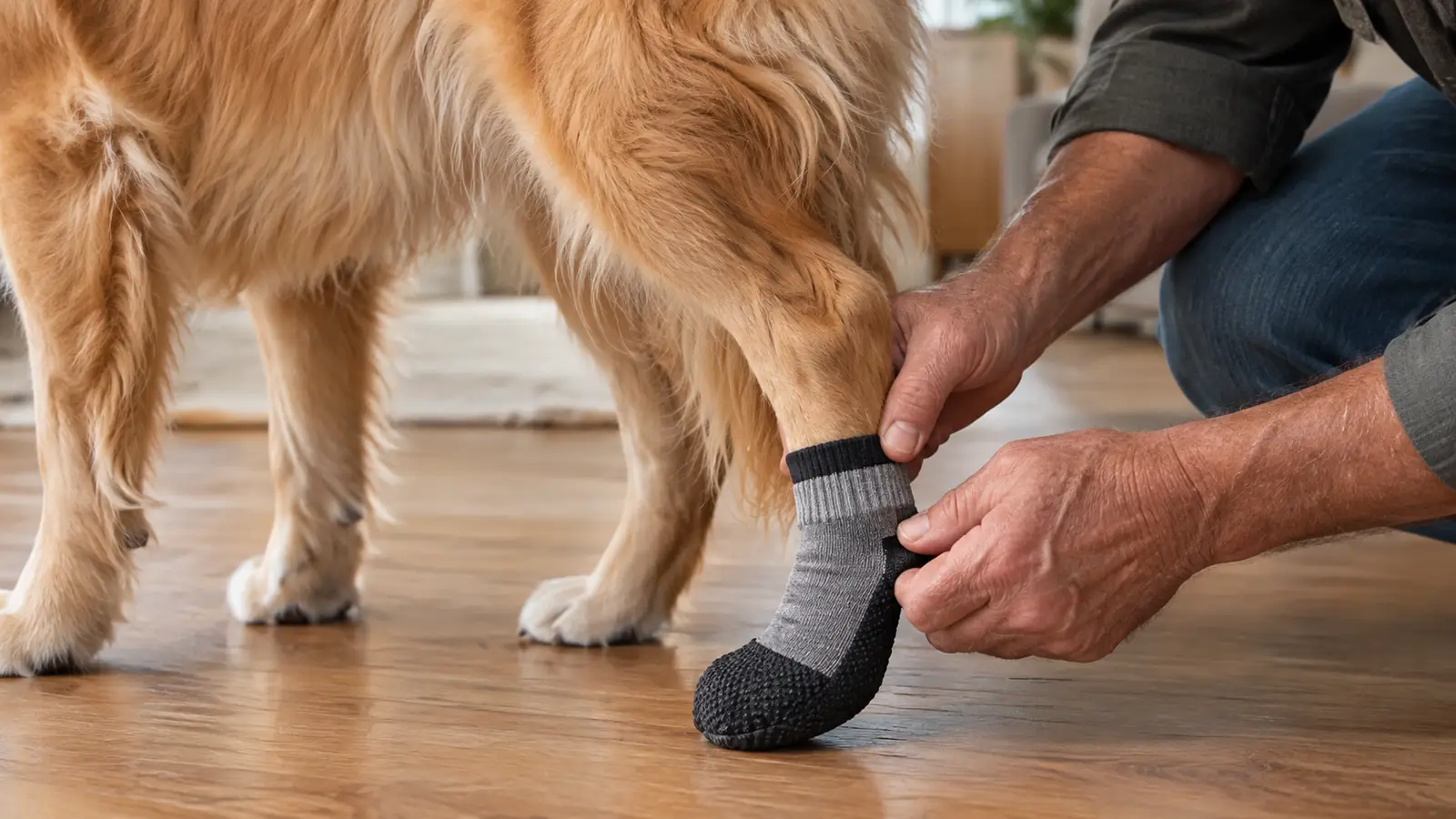
The socks have a band that goes around the ankle and a second band that goes around the pastern, which is the part of the leg just above the paw. Getting that second band positioned right took me a few tries. The first time I put them on, I left the pastern band too loose, and within ten minutes the sock had twisted halfway around his foot. He walked on the side of his paw, and I had to stop, take it off, and start over. The fix is simple: pull the sock up so the heel cup sits on the heel, smooth the toe part over his toes, and then fasten the ankle band before you adjust the pastern band. If the pastern band is too tight, it leaves a mark, and I learned to give it one notch of slack. It stays on fine.
One thing I learned the hard way: check the toe seam. The socks have a seam across the top of the toe area, and if it is not sitting evenly over his toes, it rubs. I noticed a raw spot on the top of Murphy's left back paw after a long day, and it was because the sock had shifted and the seam was pressing on the same spot for hours. After that I started checking the seam every time I put the socks on, and we have not had a repeat.
I will also say this: the socks are not a one-size-fits-most product. A friend with a 60-pound dog tried a pair and they were too big for her dog's back paws. Measure your dog before you order, and if your dog is between sizes, size down. A sock that is too big will slide around even if the grip is excellent, and a sliding sock is almost as bad as no sock. If you get the fit right, you should not have to adjust them more than once or twice a day. I check Murphy's when he comes in from outside, and mostly they are exactly where I put them.
Washing, Wear, and What Actually Lasted
I have been washing these socks for about six months now, and I have a clear picture of how they wear. The rubber nubs on the bottom are the first thing to show wear, but they have not peeled or cracked. The nubs under the ball of the paw, where Murphy pushes off, have flattened the most. The nubs around the edges and under the heel still look close to new. The fabric is a stretchy knit that has not pilled the way I expected. The elastic around the ankle is the weakest point, and it has stretched a little, but not enough to make the sock fall off.
The socks do get dirty, there is no way around it. Murphy's paws pick up dust from the floor, and the bottoms of the socks are not as fresh as the day they arrived. I tried spot cleaning them once with a damp cloth, but it was not worth it. They go in the wash every few days and come out looking close to new. I use a plain detergent with no fabric softener, because softener coats the rubber nubs and makes them less grippy. That is a tip I picked up from a comment section, and it seems to hold up. I wash them with the towels, never with anything that has zippers or hooks, because the mesh bag is what keeps them from getting snagged.
I noticed the first sign of real wear around the four-month mark, in March. The stitching where the toe part meets the body of the sock started to fray on the left sock of the pair Murphy wears most. It is not a hole, and it has not affected the grip, but it tells me these socks will not last forever. I would guess we will replace them at the six-month mark, which seems reasonable for something we use every single day. The second pair, the one that gets worn every other day, does not have the same fraying yet, so the rotation is clearly helping.
The other thing that surprised me is how much Murphy likes them. I expected a fight every morning. Instead, he stands there and lifts his paw, and he has started coming to find me in the morning when he wants them on. Some nights in the coldest part of winter he kept them on while he slept, and he seemed to sleep better for it. I think he knows the socks mean he can walk without being scared. That is worth a lot to me.
What I Liked
- Genuinely stops sliding on hardwood, even on turns
- Grip nubs lasted months of daily wear and washing
- Easy to put on once you learn the two-band fit
- Stopped Murphy from licking his front paws
- Machine washable on gentle, air dry
- Comes in a wide range of sizes
Where It Falls Short
- Fit is finicky; sizing down is often the right call
- Ankle elastic stretches over time
- Toe stitching started to fray after a few months
- Not a fix for a dog that is already very unsteady
- You will need to wash them every few days
Murphy stopped chewing at his front paws almost immediately, which was a side benefit I did not expect.
Who This Is For
DOK TigerToes are for the dog that is still steady on their feet but loses confidence on slick floors. If your dog is like Murphy, stiff in the hips but otherwise healthy, these socks can be the difference between a slow, careful walk and a slide. They are also great for dogs that lick their paws, because the fabric gives them something to feel without letting them chew.
They are especially good for a house with hardwood, tile, or laminate. If your dog has to navigate stairs, they help there too, but you should still be ready to slow down and let them take their time. And if you are tired of watching your dog hesitate at the top of the stairs, these are worth trying.
Who Should Skip It
Skip these if your dog is already very unsteady or has a condition that affects their balance. A sock is not a brace, and it will not stop a dog that is already wobbling from falling. Talk to your vet if your dog is suddenly slipping a lot, because that can be a sign of something more serious than stiffness.
Skip them if your dog will not tolerate things on their feet. Some dogs never get used to socks, and if yours is one of them, you will spend your whole day putting them back on. Also skip them if you are between sizes and do not want to deal with returns. These socks really do need to fit well to work.
Give your dog the same footing Murphy has
DOK TigerToes are still on Murphy's feet every day. Measure your dog's paw, check the sizing chart, and see today's price on Amazon.
Amazon Check Today's Price on Amazon →