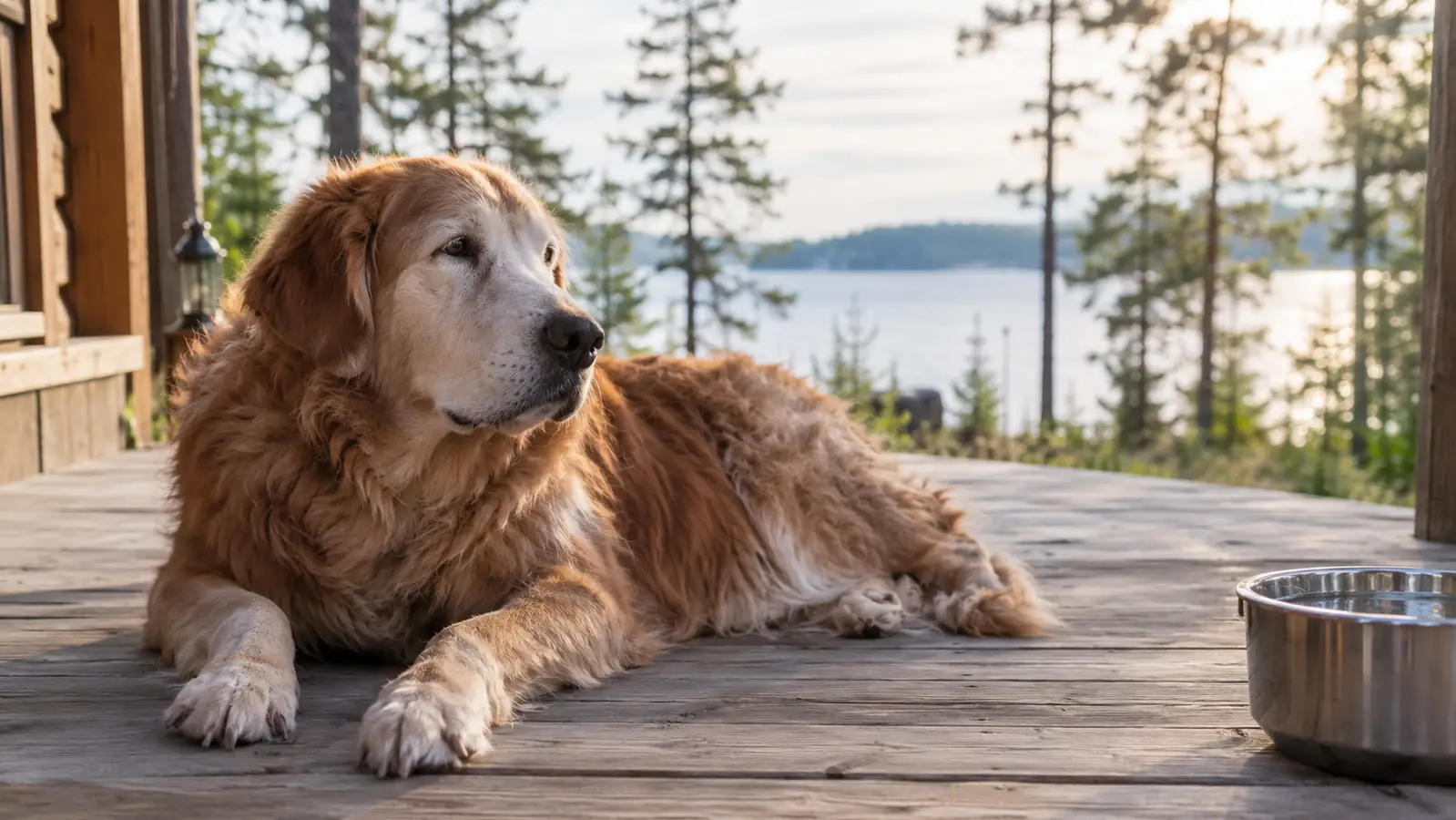
You know the moment. The dog who used to launch himself off the dock now stands at the bottom of the stairs for a full minute before he tries the first step. Or he looks at the truck tailgate, sighs, and walks around to the passenger door instead. That was Murphy last spring. He is a 12-year-old yellow Lab, about 78 pounds, and his hips and elbows have gotten noticeably stiff over the last two years. He is slow to get up in the morning and hesitates at the stairs, the tailgate, and the boat ladder. This is the routine that got him moving better, and I am going to walk you through it.
I am Darlene Vandermeer. I live near Coeur d'Alene, Idaho, with my husband Ray, and Murphy has been my swimming buddy since he was a puppy. When he first started hesitating at the stairs, I tried the things most people try: a warmer bed, more treats, shorter walks. None of it changed anything. What finally helped was sitting down with our vet, and the first thing he suggested was a joint supplement. We chose Nutramax Laboratories Dasuquin MSM soft chews for large dogs, and Murphy has had one every morning for over two years. The chews were only one piece of the plan, though. The other four parts are watching how he moves, protecting his weight, fixing his footing, and changing how we walk him, and they matter just as much.
The Soft Chew Our Vet Suggested, and the One Murphy Still Eats Every Morning
Nutramax Laboratories Dasuquin MSM soft chews for large dogs are the supplement our vet recommended for Murphy. Talk to your own vet first, then check today's price on Amazon.
Amazon Check Today's Price on Amazon →The Five-Part Routine We Use Every Day
I want to say plainly that none of this happened fast. Murphy did not bounce back in a week. He improved over months, and the improvement came from all five parts together, not from any single thing. If you are starting down this road with your own dog, give the routine time and keep notes, because the changes are easy to miss when you live with them every day. I kept a little notebook on the kitchen counter, and every Sunday I wrote down how Murphy got up that week. It took thirty seconds, and it was the most useful thing we did. And when in doubt, we asked our vet. That is the rule that kept us from chasing fads.
Step 1: Keep a Baseline of How He Moves
Before you change anything, take a short video of your dog getting up from a nap and walking across the room. Do it on the same three mornings, and write down what you see. Does he get up on the first try? Does he limp after the first few steps? Does he favor one leg? For Murphy, the notes were simple: slow to rise, stiff in the back end, worse on cold mornings. Cold mornings were the clue that told us weather mattered, and it still does.
That baseline matters more than it sounds like it does. A joint supplement and a new routine take weeks to show results, and if you do not have a record of where you started, you will not be able to tell what is working. You will also have something concrete to show your vet. Our vet asked us three questions: how Murphy gets up, how he walks after ten minutes, and how he does on stairs. We had answers because we had been watching. That record also gave us permission to see improvement later, because we could compare the videos side by side.
One more thing we learned: dogs hide pain well. Murphy still wagged his tail and wanted his breakfast. The stiffness showed up in the small things, the hesitation, the circling before he lay down, the way he stopped jumping onto the porch. Watching for those small things is the whole job of this step.
Step 2: Protect His Weight Before You Add Anything Else
Extra weight is the heaviest load your dog's joints will ever carry. When our vet weighed Murphy, he was 82 pounds, a little over where he should be for his frame. We were not feeding him table scraps, but we were generous with treats, and he had slowed down enough that he did not burn them off. Our vet said that getting him back to about 78 pounds would do more for his hips than any supplement.
So we cut the extras. Murphy's breakfast and dinner stayed the same, but the treats became smaller, and we swapped some of his kibble for a handful of green beans so his bowl still felt full. It took about three months, and he did not seem to mind. By the time his weight came down, we could already see him getting up a little easier. It was not dramatic, but it was the first real improvement we saw, and it came before the supplement had time to work.
If your dog is carrying extra weight, talk to your vet about a target and a timeline before you cut food. Dogs should not lose weight fast. Slow and steady is the point, and your vet can tell you what is right for your dog's breed and size.
Step 3: Make the Floors, Stairs, and Tailgate Easier
Murphy's stiffness showed up most on hard surfaces and stairs. We have hardwood floors and a staircase to the bedrooms, and he would stand at the bottom of the stairs and just look. The fix was cheaper than I expected: runners on the stairs and a few area rugs on the hardwood. The extra grip gave him the confidence to try, and within a week he was using the stairs again at his own pace. Runners are not glamorous, but they are the difference between a dog who uses the stairs and a dog who avoids them.
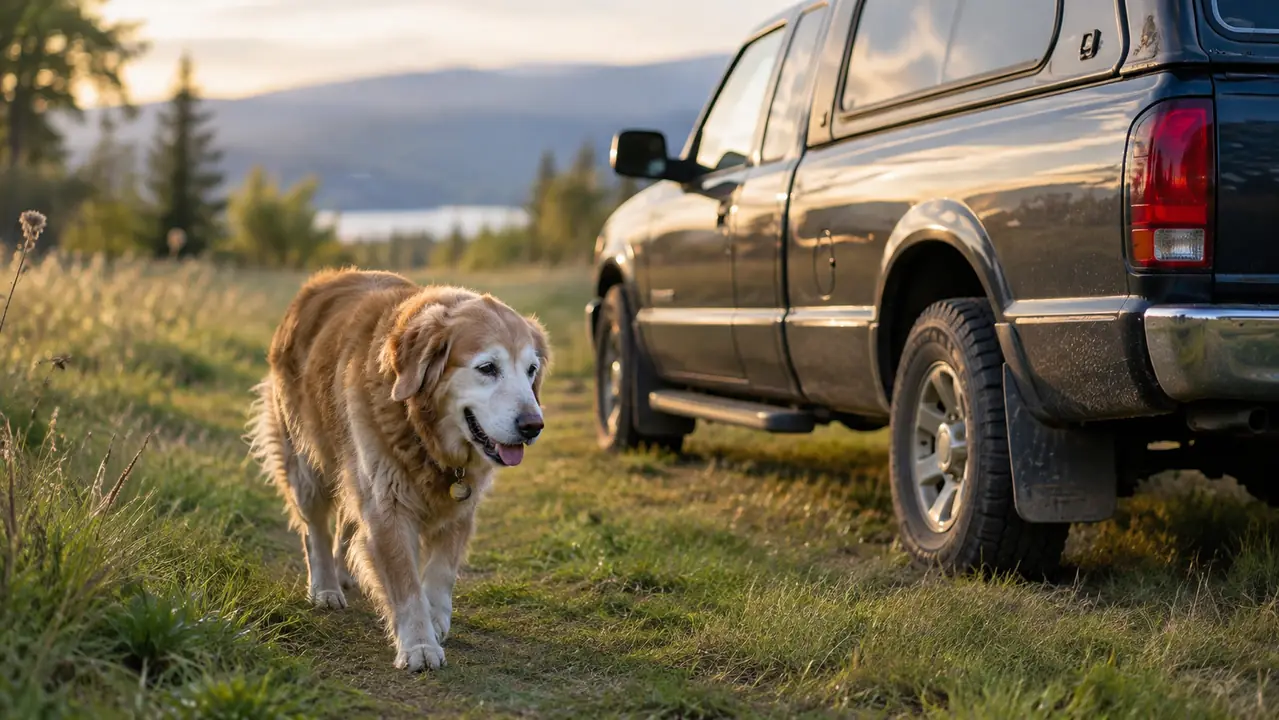
The truck tailgate was a different problem. Murphy is 78 pounds, and I am not going to lift him. We bought a folding ramp for the tailgate, and we practiced with it in the driveway for a few days. Now he walks up and down it like it has always been there. The boat ladder is still his hardest thing, so on the boat he wears a life vest and we help him in and out of the water. He still loves the water more than anything, and we are not about to take that away from him.
Look around your house for the spots where your dog hesitates. It might be a step into the yard, a slippery kitchen floor, or the gap between the porch and the door. A rug, a ramp, or a non-slip mat can fix most of these for very little money, and they work all day long, not just on walk days.
Step 4: Trade One Long Walk for Two Short, Warm Ones
Murphy used to get one long walk in the afternoon. By last spring, he was lagging by the end of it, and the next morning he was stiffer. Our vet's suggestion was to split the walk in half and add a slow warm-up. Now we do ten slow minutes in the morning and ten to fifteen in the afternoon, and we let Murphy set the pace. Some days he wants to go farther. Some days he turns for home. We follow him. On days when he is stiffer, we do two very short loops instead of one longer one.
The warm-up matters more than the distance. We start at a walk so slow it barely counts as a walk, then speed up as Murphy loosens. On cold mornings we do the first block at a crawl. It looks funny, but it works, because stiff joints move better once they have had a few minutes to warm up.
For dogs that love the water, swimming is the best exercise there is. Murphy has always swum off the boat, and swimming works his muscles without pounding his joints. If your dog is a swimmer, ask your vet whether a few minutes of swimming a few times a week would help. For Murphy, it is the highlight of his week. We keep the sessions short and let him decide when he is done.
Step 5: Start a Joint Supplement and Give It a Full Six Weeks
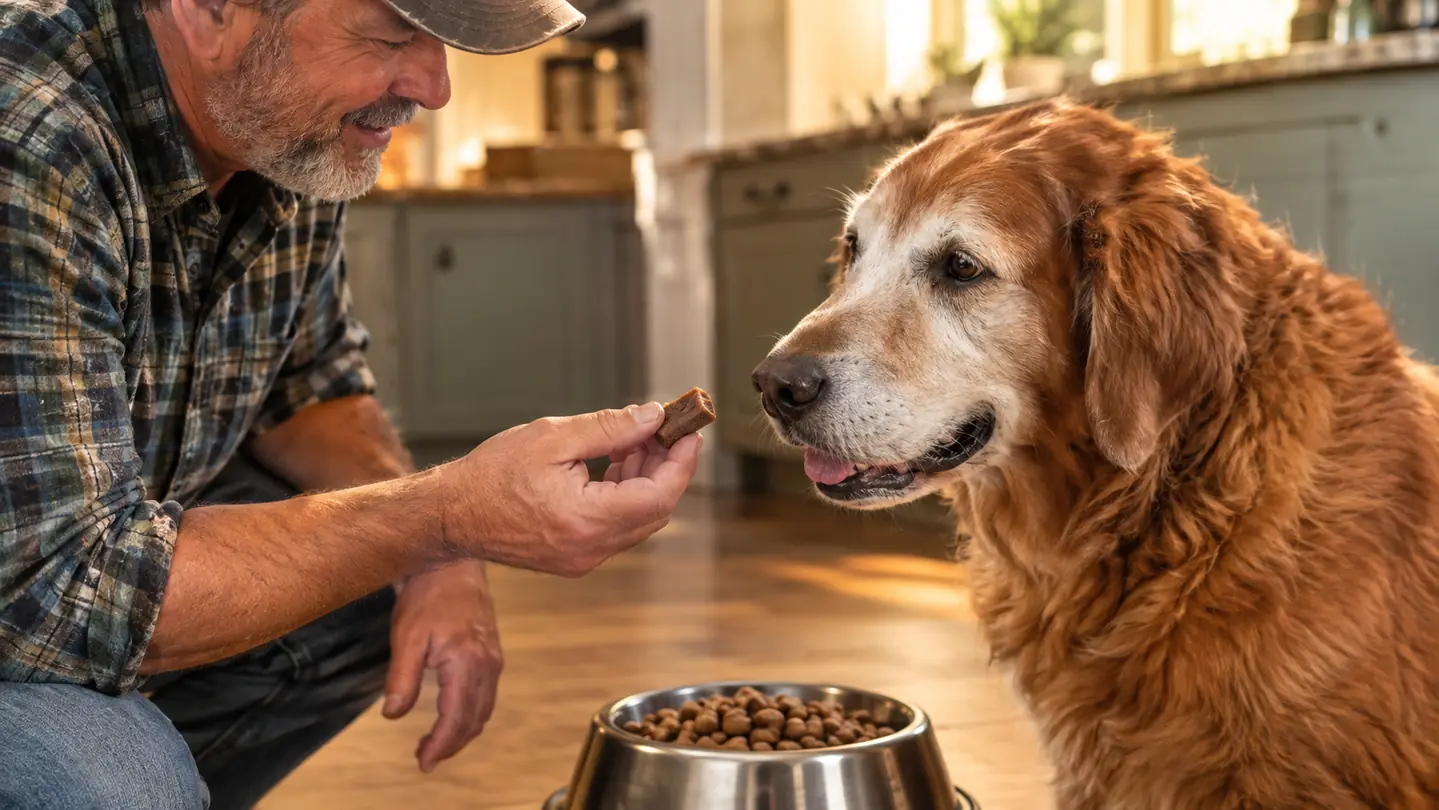
This is where Nutramax Laboratories Dasuquin MSM soft chews came in for us. Our vet recommended them for a dog Murphy's size, and the soft chew form made it easy. Murphy thinks it is a treat. He gets one every morning with his breakfast, and we give it at least six weeks before we judge anything, because joint supplements do not work overnight. Six weeks is the shortest window I would trust, and two months is better.
What we noticed, in order: after about three weeks, Murphy stopped circling before he lay down. After six weeks, he was getting up on the first try most mornings. After two months, he stopped walking around the truck tailgate and started using the ramp without being called. The change was not dramatic. It was gradual, and it was real.
A few honest notes. The chews did not make Murphy young again. He still has stiff mornings, especially when the weather turns cold, and he still needs help with the boat ladder. But the difference between last spring and now is the difference between a dog who hesitates and a dog who tries. Talk to your vet before starting any supplement, and follow the dosing on the label for your dog's weight. For a dog Murphy's size, the 84-count container lasts us close to three months.
What Else Helps
A few smaller things rounded out the routine. Murphy sleeps on an orthopedic bed with a bolster, and he gets up easier from it than he did from the flat mat he used to have. We keep his nails trimmed, because long nails change the way a dog stands and can make a stiff dog slide on hard floors. And we stopped letting him jump out of the truck and off the porch. Every landing is a small shock to the hips, so we use the ramp and the steps every time.
Warmth helped too. On cold mornings Murphy is noticeably stiffer, so we keep the house a little warmer in the winter and we put a pet-safe heating pad under his bed, the kind made for dogs, with a chew-resistant cord. Our vet approved it. We also rub his hips and elbows gently before walks, the way you would warm up your own hands before lifting something heavy. He leans into it, so I know it helps.
None of these things are dramatic on their own. Together they add up to a house that is easier for an old dog to move around in, and that is the whole goal.
By the end of the second month, Murphy was getting up on the first try most mornings, and he stopped walking around the truck tailgate.
What I Would Do Differently
If I could go back two years, I would have started the weight conversation and the supplement at the same time, instead of waiting until Murphy was clearly struggling. I would also have bought the ramp the first week. We wasted a lot of mornings watching him circle the tailgate before we admitted he needed help. Dogs do not get less stiff while you make up your mind.
The other thing I would do sooner is talk to our vet earlier. I spent a few weeks guessing, and the guesses did not cost money, but they cost time, and time is the one thing an old dog does not have extra of. A five-minute conversation with your vet can save you a month of trial and error. Our vet did not charge us for the conversation, and it changed the whole plan.
When to Call Your Vet
I want to be honest about something. A daily routine helps with the slow stiffness of an older dog, but it is not a diagnosis. If your dog is suddenly lame, if he will not put weight on a leg, if he cries when he moves, or if he stops eating, do not wait for a routine to fix it. Call your vet that day. Sudden pain and gradual stiffness are different things, and only your vet can tell them apart. Better to make the call and have it be nothing than to wait and have it be something.
And if you are thinking about a joint supplement, have that conversation before you buy. Our vet knew Murphy's history, his weight, and his joints, and that is why the recommendation fit. Your vet can do the same for your dog.
The Same Soft Chews Murphy Has Eaten Every Morning for Two Years
Nutramax Laboratories Dasuquin MSM soft chews for large dogs are the supplement our vet recommended and the one we still use daily. Talk to your vet first, then check today's price on Amazon.
Amazon Check Today's Price on Amazon →