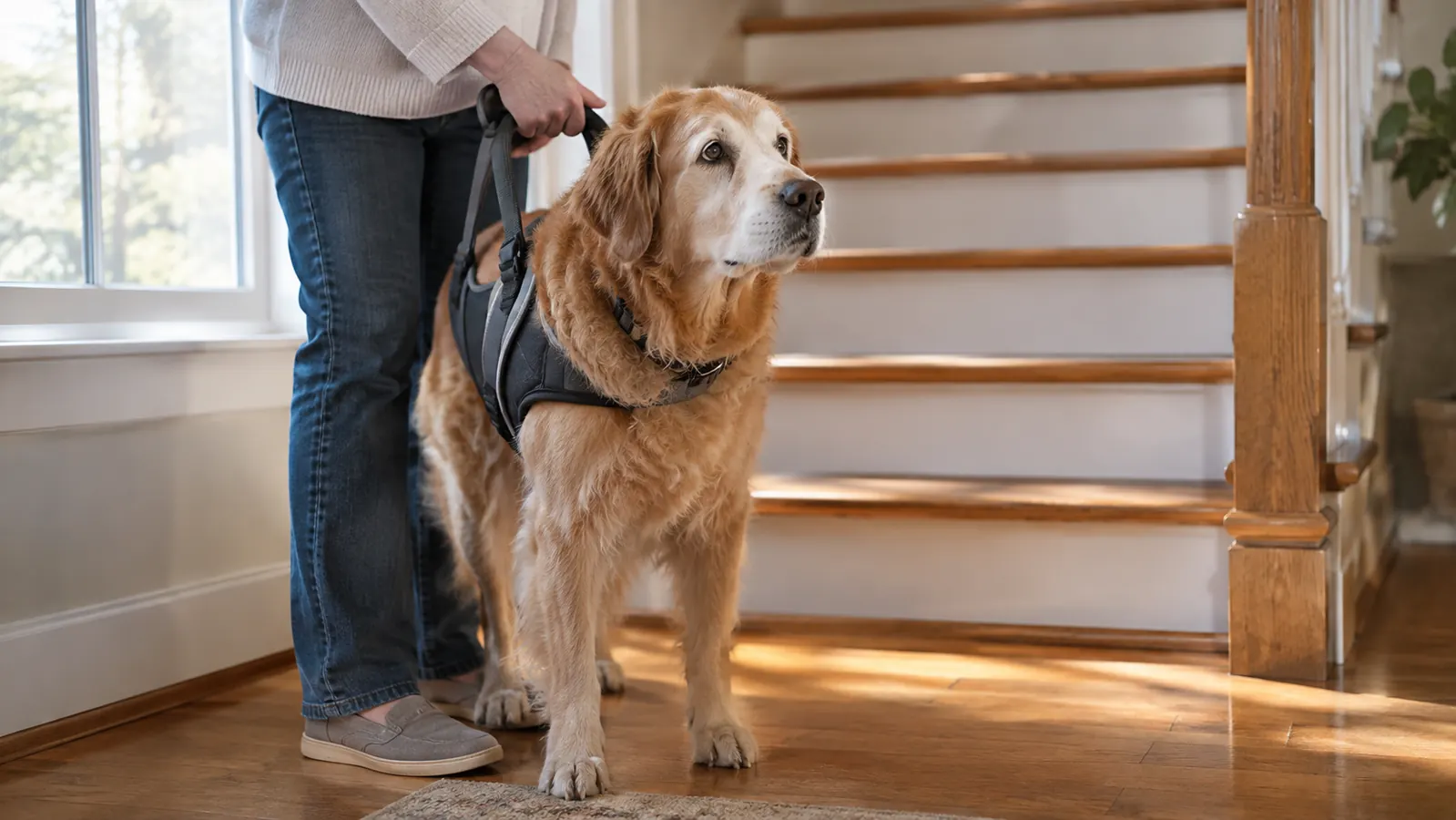
Murphy used to take the stairs two at a time. Now, at twelve years old with stiff hips and elbows, he stands at the bottom of the staircase and looks up at me like he is working up the courage. Some mornings he makes it halfway and stops, and I can see his back legs start to shake. Other mornings he will not even try until I come over and stand beside him. The LOOBANI Dog Lift Harness for Large Dogs changed that routine for us, and in this article I will walk you through exactly how we use it to help him up and down the stairs safely, step by step.
Before the harness, I tried a folded towel under his belly and a second person on the step above him. The towel worked okay on flat ground but slid around on the stairs, and pulling up on his belly put pressure in the wrong place. The second-person method worked when my husband Ray was home, but it fell apart on weekdays when I was alone with Murphy. The LOOBANI harness gives me a grip where his strength actually is, around his chest and his hind end, so I can steady him without bending over and without him feeling like I am dragging him.
The harness that keeps a 78-pound senior dog steady on the stairs
The LOOBANI Dog Lift Harness supports the hind end so you can guide a stiff older dog up and down stairs without lifting all of his weight. It takes about two minutes to fit and a few days for the dog to get used to it.
Amazon Check Today's Price on Amazon →Why a Lift Harness Works for Stairs
A lift harness is not the same as a sling or a wheelchair for a dog. A sling takes most of the weight and is meant for dogs that cannot walk at all. A lift harness like the LOOBANI takes just enough weight off the back end to help a dog who can still walk but struggles with stairs. That matters because a dog who can use his legs keeps more muscle tone, and muscle tone is what keeps an older dog moving longer.
The other reason a harness works better than a towel is where the support sits. A towel under the belly pulls up in the middle, which makes a dog's back arch and his rear legs reach forward awkwardly. The LOOBANI harness supports the hind end directly, right at the hips, so the rear legs can move in a more natural stepping motion. Murphy's front legs do the reaching, and I just keep his back end from lagging behind.
The handles also make it safer for you. You are not leaning over and grabbing at a moving dog on a staircase. You are standing beside him, mostly upright, with a grip that does not slip. For a 78-pound dog like Murphy, that is the difference between being able to help him and being afraid to try.
Step 1: Fit the Harness While Your Dog Is Standing
Put the harness on when Murphy is standing on flat ground, not when he is already lying down. The LOOBANI harness has one wide band that goes around the chest, just behind the front legs, and a second band that goes around the belly, just in front of the back legs. Standing position lets you see where both bands sit before you tighten anything. If your dog is lying down when you try to fit it, the bands end up in the wrong place and you will have to start over.
I do this in the kitchen where there is room to move around him. The first time, he looked at me like I was putting on his winter coat in July, but he stood still because he is used to being handled. If your dog is nervous about new gear, give him a few treats and go slowly. Let him sniff the harness before you put it on. The goal is a calm dog before you ever get near the stairs, because a dog who is worried about the harness will not pay attention to his footing.
Make sure the chest band is snug but not tight enough to rub. You should be able to slip two fingers flat under the band. The belly band sits behind the ribs so it does not push on his stomach. If the harness shifts when you lift the handles, it is not fitted right yet, so take it off and start again. A loose harness will do more harm than good on a staircase.
Step 2: Adjust the Straps So the Handles Sit Over the Hips
The LOOBANI harness has a handle over the back, near the shoulders, and another handle lower, over the hind end. That lower handle is the one that matters on the stairs. It should sit right over the widest part of the hips so that when you lift, you are supporting the rear legs instead of pulling up on the belly. I check the position every time I put it on, because the harness can twist while a dog is walking.
Adjust the straps so both handles are easy to grab without you bending over. I am not very tall and Murphy is a tall Lab, so I keep the straps fairly short. If you are taller, you will want them a little longer. The right fit is the one where you can stand mostly upright while you walk beside him. If you are reaching down to grab the handles, you will be in pain before you reach the top of the stairs.
Test the fit by lifting the rear handle just an inch or two. Murphy should keep all four feet on the floor with just a little weight taken off his back end. If his rear legs dangle, you have the straps too short. If you feel all of his weight, they are too long. You want to feel maybe ten or fifteen pounds of his weight in the handle, not all seventy-eight.
Step 3: Practice Walking on Flat Ground First
Do not start on the stairs. For two or three days, we practiced in the living room and down the hallway. I would hold the rear handle with light tension, just enough to take a few pounds off his hips, and we would walk a lap around the house. He got used to the feel of the harness and learned that the handle meant I was helping, not holding him back. By the third day he was walking ahead of me instead of waiting for me to catch up.
Watch how he walks while you practice. With the LOOBANI harness, Murphy's back legs move more normally because he does not have to work as hard to swing them forward. That is also the time to check for rubbing. A harness that fits on day one can still shift after a few walks, so check the straps again before the first real stair attempt. Look for any red marks or areas where the fur is matted down.
Practice the stop and start too. On the stairs, you will need to pause at every step, so your dog needs to know that a gentle tug on the handle means wait. We used a quiet 'wait' command. Keep the practice sessions short, five minutes at a time, so your dog does not get tired or frustrated. A tired dog is more likely to stumble, and you want his first stair experience to be a good one.
Step 4: Take the Stairs With a Support Position
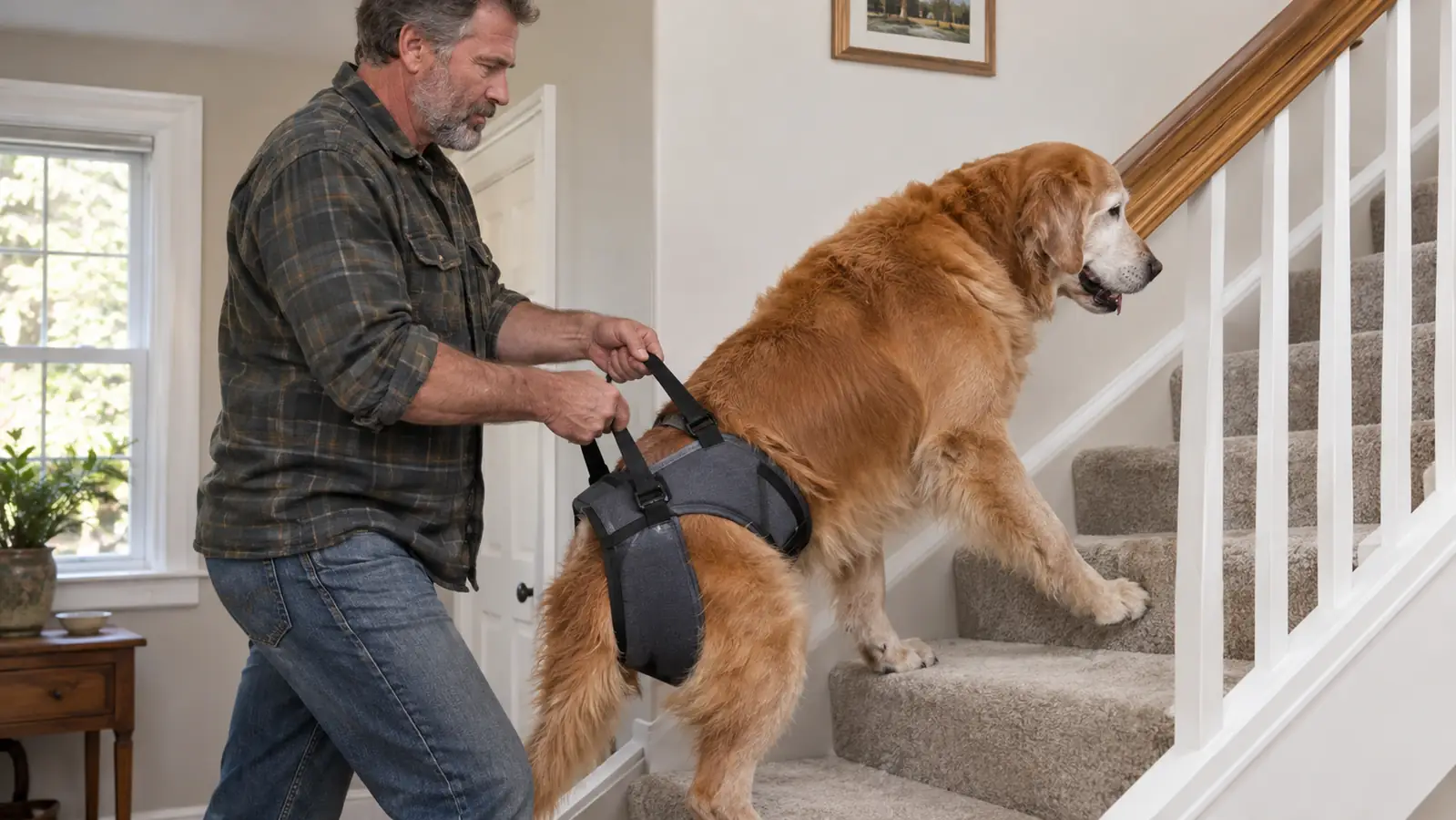
When Murphy was ready, we started with the staircase to the bedrooms because it is the one he uses every night. I stand beside him, slightly behind his hip, with my left hand on the rear handle and my right hand on the chest handle. My job is not to lift him up the whole flight. It is to take enough weight off his back end that his rear legs can keep up with his front legs. The harness does the supporting, and I just guide.
We go one step at a time. I lift gently on the rear handle as he steps up with his front legs, then I let the handle follow as he brings his back legs up. The chest handle keeps him from lurching forward. Going down is the same idea but slower. I keep the rear handle snug so his hips do not drop faster than his front end, and I let him set the pace. Some days he wants to fly down, and other days he takes each step like it is his first.
Keep your own back straight and let your legs do the work. The harness helps your dog, but it should not turn you into a crane. If you find yourself bending over and straining, shorten the straps so the handles sit higher. And if your dog is too heavy for you to support safely, that is the moment to talk to your vet about other options. There is no shame in asking for help, and a fall on the stairs would be worse for both of you.
Step 5: Build a Routine and Watch His Signs
Dogs do better with a routine. We do the stairs at the same times every day, first thing in the morning and right before bed. Murphy knows the harness means we are heading up together, and he waits at the bottom of the stairs for me to put it on instead of standing there hesitating. The routine took about a week to stick, and now he actually seems relieved when he sees me reach for the harness.
Watch his body language as you climb. If he is panting hard, stopping to rest, or dragging his rear toes, slow down or split the trip with a pause at the landing. The harness is a tool to keep him moving comfortably, not a way to push him further than he wants to go. When pain is sudden or severe, call your vet. You know your dog better than anyone, and you will be able to tell the difference between a stiff morning and a real problem.
After a few weeks, you will both get faster and smoother. Murphy still needs the harness every single time, and I expect he always will. That is okay. Helping him up the stairs is a small price to pay for all the years he spent jumping off the boat and chasing the grandkids around the yard. He does not have to be the dog he was at five. He just has to be comfortable being the dog he is now.
Common Mistakes to Avoid
The biggest mistake I see people make is lifting the dog by the belly band alone. That puts all the pressure on the stomach and makes the dog brace against you. Always use the rear handle over the hips, and use the chest handle to steady the front end. The two handles work together, and you want both hands on them whenever you are on the stairs.
The second mistake is expecting the harness to do everything. It will not carry your dog up the stairs, and it should not. If you are hauling most of his weight, the fit is wrong or the harness is the wrong tool. The LOOBANI is for dogs who can still walk but need help with balance and rear leg support. A dog who cannot bear weight at all needs a different conversation with your vet.
The third mistake is rushing. I know it is hard to watch your dog struggle at the bottom of the stairs, but pushing him to go faster will only make him more hesitant. Give him time to find his footing on each step. Celebrate the small wins. The first time Murphy made it up the whole flight without stopping, I nearly cried, and he looked very proud of himself.
What Else Helps
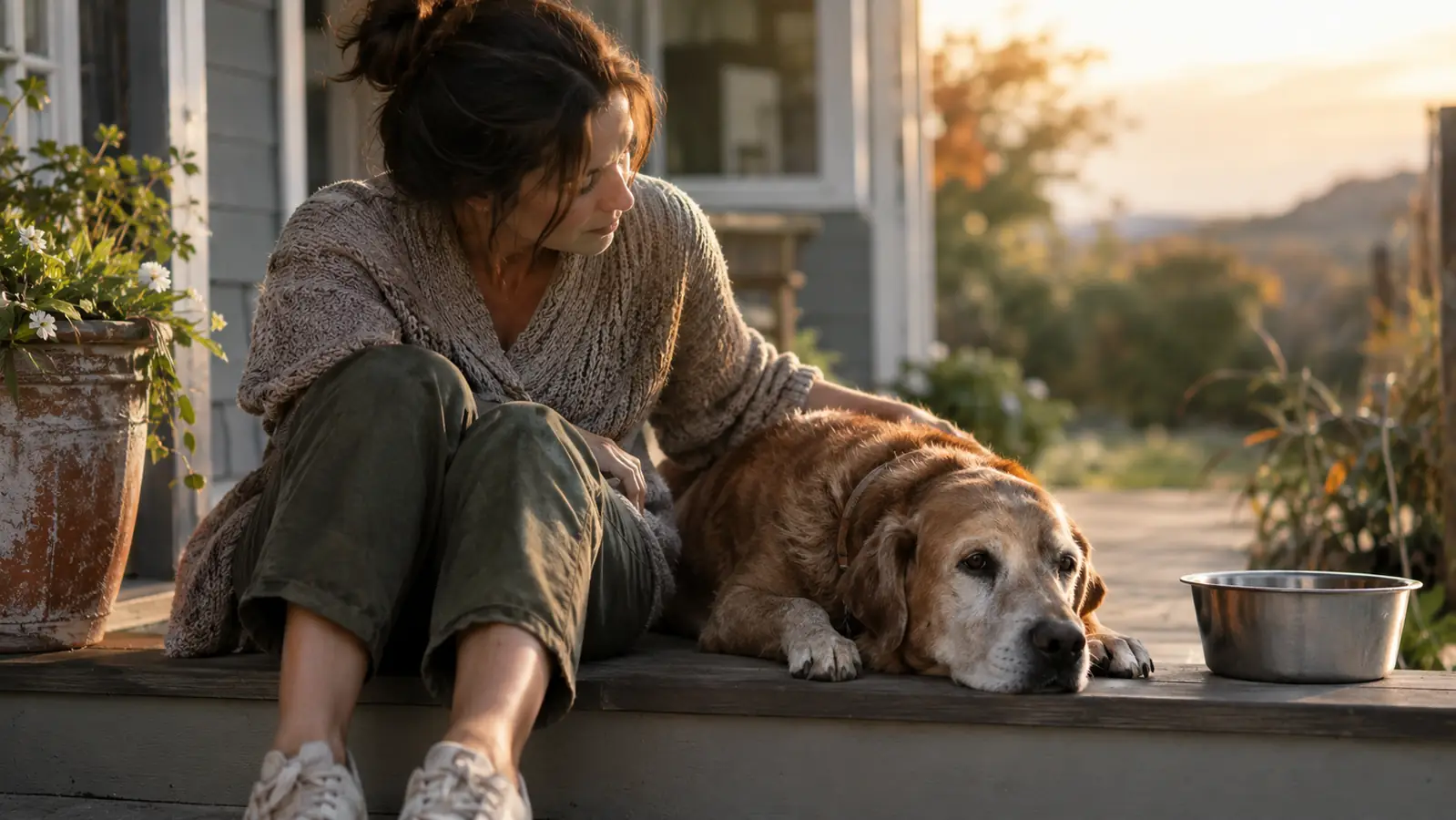
The harness solved the stairs, but it is only part of the picture for a senior dog with stiff joints. We also put rugs down on the hardwood floors so Murphy does not slide when he gets up from his bed. Our vet suggested a joint supplement, and we give it to him every morning with his breakfast. Talk to your vet before starting anything new, especially if your dog has other health conditions.
Keep his nails trimmed short. Long nails catch on carpet and make a dog hesitant on stairs. We also moved his food and water bowls to the main floor so he does not have to climb more than he needs to. And we take him for shorter, more frequent walks instead of one long one, which keeps his muscles warm without wearing him out. A warm dog moves better than a cold one, so we do a little indoor walking before we even open the door.
If you are still deciding whether a lift harness is right for your dog, [my long-term review of the LOOBANI harness](/loobani-lift-harness-review-long-term) covers what it is like to use it every day for months. I also [compared it side by side with the Pick for Life sling](/loobani-harness-vs-pick-for-life-sling), and I put together [ten reasons a rear support harness helps senior dogs](/10-reasons-rear-support-harness-helps-senior-dogs). All three are worth a read before you buy.
The first morning we used it, Murphy went up the whole staircase without stopping once.
Ready to make the stairs easier for your senior dog?
The LOOBANI Dog Lift Harness for Large Dogs is the one we reach for every single day. It fits in about two minutes, and most dogs adjust within a week.
Amazon Check Today's Price on Amazon →